AI Private Market Investing: How Smart Capital Is Winning the Race to Back Tomorrow's AI Giants
From Anthropic's $30 Billion Round to Concentrated VC Portfolios — A Complete Guide to Understanding, Evaluating, and Accessing AI's Biggest Private Market Opportunitylast updated Tuesday, July 21, 2026
#AI Private Market Investing #private market
| | by Sidra Jabeen | Content Manager, Paperfree Magazine |

QUICK LINKS
ad
Get Access to Real Estate Investment Opportunities
AI Is No Longer a Bet — It's the Bet
The artificial intelligence market has crossed a definitive threshold. What was speculative in 2023 is now structural in 2026. Anthropic's recent $30 billion funding round did not just set a private market record — it crystallized a reality that sophisticated investors have been preparing for: the most consequential wealth creation event of this decade is unfolding in AI's private markets, and access is the new alpha.
For investors focused on alternative investments, this shift presents both an unprecedented opportunity and a challenge. The opportunity lies in the sheer scale of value being created before these companies ever reach public markets. The challenge is that the traditional rules of venture capital — diversification, multi-year deployment, broad sector exposure — are being rewritten in real time.
This article breaks down everything investors need to know about AI private market investing in 2026, including the structural forces driving capital concentration, the strategies separating top-performing venture firms from the rest, and how platforms and access models are evolving to democratize participation in these once-exclusive opportunities.
The State of AI Private Markets in 2026
The AI private market landscape looks fundamentally different from even two years ago. The post-2022 correction imposed a discipline that filtered out speculative excess and rewarded companies with genuine unit economics, defensible technology, and clear monetization pathways.
Today, a small group of foundational AI companies commands the majority of late-stage private capital. These are not early-stage moonshots. They are operating at scale, generating billions in revenue, and approaching profitability milestones that would make many public companies envious.
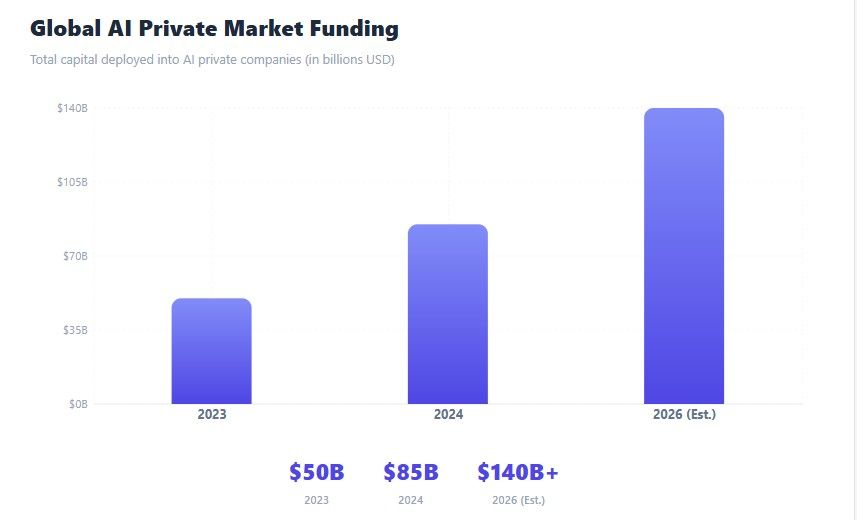
Key Market Metrics: AI Private Markets 2026
| Metric | 2023 | 2024 | 2026 (Est.) |
|---|---|---|---|
| Total AI private funding (global) | $50B | $85B | $140B+ |
| Median late-stage AI valuation | $2.5B | $6B | $15B+ |
| Number of AI companies valued at $10B+ | 8 | 14 | 25+ |
| Average VC fund deployment period | 3–4 years | 2–3 years | 18–24 months |
| Projected AI market revenue (total) | $200B | $370B | $620B+ |
These numbers tell a clear story. Capital is flowing faster, valuations are rising, and the window to invest in category-defining AI companies before they go public is narrowing.
Why Venture Capital Is Concentrating Around AI
One of the most significant shifts in venture capital strategy has been the deliberate move toward concentration. Rather than building portfolios of 40 to 60 companies across multiple sectors, leading VC firms are now deploying larger checks into fewer, higher-conviction AI positions.
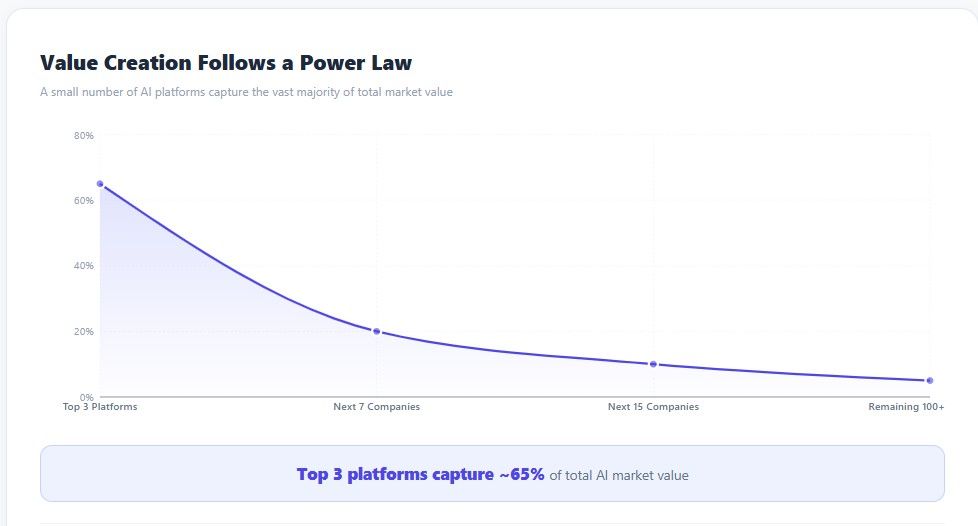
This is not recklessness — it is adaptation. In frontier technology markets, value creation follows a power-law distribution. A small number of platforms capture the vast majority of economic value. Think of what happened with cloud computing (AWS, Azure, Google Cloud) or mobile operating systems (iOS, Android). The same structural dynamic is playing out in AI.
Firms like Sequoia Capital, Lightspeed Venture Partners, General Catalyst, and Accel have recognized this pattern. Their participation in successive Anthropic financing rounds reflects not just belief in a single company, but conviction in a broader thesis: the infrastructure layer of AI will be dominated by a handful of foundational model companies, and being on their cap table early compounds advantages over time.
Top VC Firms Actively Backing Foundational AI (2024–2026)
| VC Firm | Notable AI Investments | Strategy Focus |
|---|---|---|
| Sequoia Capital | Anthropic, OpenAI ecosystem | Foundational models, AI infrastructure |
| Lightspeed Venture Partners | Anthropic, applied AI stack | Enterprise AI, model deployment |
| General Catalyst | Anthropic, AI-native SaaS | AI-first business models |
| Accel | Anthropic, vertical AI | Industry-specific AI platforms |
| Andreessen Horowitz (a16z) | Mistral, AI developer tools | Open-source AI, developer ecosystem |
| Thrive Capital | OpenAI, AI applications | Consumer and enterprise AI |
The research supports this approach. Academic and industry studies consistently show that returns in venture capital persist across fund generations. Top-quartile managers are significantly more likely to repeat their outperformance, driven by superior deal flow, founder relationships, and ecosystem positioning.
The Access Problem: Why Getting In Is Harder Than Picking Winners
In traditional public market investing, access is democratic. Anyone can buy shares of NVIDIA, Microsoft, or Alphabet through a brokerage account. In private markets, the opposite is true. The most valuable AI companies are funded through invitation-only rounds, with allocation determined by relationships, reputation, and prior participation.
This creates a structural barrier for most investors. Even family offices and institutional allocators with significant capital often struggle to secure meaningful allocation in oversubscribed AI rounds. Anthropic's financing rounds, for example, have been heavily oversubscribed, with demand far exceeding available allocation.
This access gap is precisely where alternative investment platforms are adding value. By maintaining long-standing relationships within the venture ecosystem, platforms that specialize in private market access can offer qualified investors participation in deals that would otherwise be completely inaccessible.
The critical distinction for investors is understanding the difference between AI beta and AI alpha. Broad exposure to AI-themed public equities gives you beta — you capture the sector's general momentum. Concentrated access to the private companies that will define entire categories gives you alpha — the kind of outsized, asymmetric returns that make alternative investments compelling in the first place.
Evaluating AI Private Market Opportunities: A Framework for Investors
Not every AI company at a high valuation is a good investment. The post-2021 correction taught the market that growth without economics is a recipe for value destruction. In 2026, the evaluation framework for AI private investments has matured significantly.
Due Diligence Framework for AI Private Investments
| Evaluation Criteria | What to Look For | Red Flags |
|---|---|---|
| Revenue Quality | Recurring contracts, enterprise adoption, low churn | One-time deals, heavy reliance on a single customer |
| Unit Economics | Positive gross margins (ideally 70%+), improving cost per query | Burning cash with no margin trajectory |
| Technical Moat | Proprietary models, unique data advantages, research depth | Wrapper on third-party APIs, no differentiation |
| Monetization Path | Clear pricing models, proven willingness to pay | Free users with no conversion strategy |
| Capital Efficiency | Revenue growth outpacing capital consumption | Raising ever-larger rounds with flat revenue |
| Team & Talent | Top-tier AI researchers, experienced operators | High turnover, talent flight to competitors |
| Governance | Transparent cap table, aligned incentives, clean structure | Complex liquidation preferences, misaligned stakeholders |
Anthropic's projected numbers illustrate what a strong profile looks like: the company expects up to $17 billion in cash flow by 2028, with gross profit margins reaching 77%. These are not speculative projections from a pre-revenue startup — they are forward metrics from a company already operating at significant scale.
The Role of Alternative Investment Platforms
The democratization of access to top-tier private market opportunities is one of the most important trends in alternative investments today. Historically, the only way to invest in a company like Anthropic was to be a large institutional investor or an ultra-high-net-worth individual with direct VC relationships.
Alternative investment platforms are changing this dynamic by aggregating demand, negotiating allocations, and providing the governance and transparency infrastructure that individual investors require. The best platforms focus on several key principles.
First, they prioritize manager quality over deal volume. Rather than offering dozens of mediocre opportunities, they partner with proven venture managers who have demonstrated persistent outperformance. Second, they provide structural transparency — investors understand exactly where they sit in the cap table, what rights they hold, and how incentives are aligned. Third, they apply rigorous diligence that triangulates perspectives across multiple venture firms, reducing reliance on any single manager's judgment.
For investors considering AI private market exposure, the platform's access network and structural rigor matter as much as the underlying investment thesis. A great company accessed through a poorly structured vehicle can still produce disappointing outcomes for end investors.
Risks Investors Should Understand
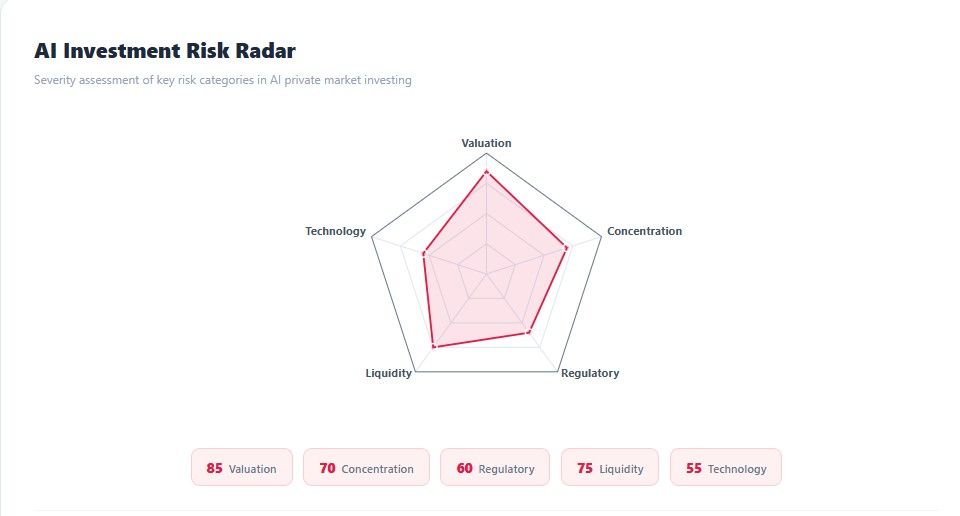
No discussion of AI private market investing would be complete without an honest assessment of risks. While the opportunity is compelling, the risks are real and must be managed thoughtfully.
- Valuation risk is the most obvious concern. Late-stage AI companies are being priced at levels that require sustained, aggressive growth to justify. If growth decelerates or monetization timelines extend, even fundamentally strong companies can deliver underwhelming returns from elevated entry points.
- Concentration risk has increased as VC deployment cycles have shortened. Funds that were expected to deploy over three to four years are now investing within 18 to 24 months, creating vintage concentration that amplifies both upside and downside.
- Regulatory risk is evolving rapidly. Governments worldwide are developing AI governance frameworks that could impact business models, data usage, and competitive dynamics in ways that are difficult to predict.
- Liquidity risk remains inherent to private markets. These investments have multi-year holding periods, and secondary market pricing can be volatile and opaque.
- Technology risk should not be underestimated. The AI landscape is evolving at an extraordinary pace. Today's leading model could face disruption from open-source alternatives, novel architectures, or shifts in computational paradigms.
Sophisticated investors manage these risks through diversification across fund vintages, careful manager selection, structural protections in deal terms, and realistic return expectations calibrated to entry valuations.
What Comes Next: The 2026–2028 Outlook
The next two to three years will be decisive for AI private markets. Several key themes are likely to shape the landscape.
The IPO window for major AI companies will open. Multiple foundational AI companies are approaching the scale and profitability metrics that typically precede public listings. This creates a natural liquidity event for private market investors, but also compresses the remaining window for private participation.
Enterprise AI adoption will accelerate. As large organizations move beyond AI experimentation and into production deployments, revenue growth at leading AI companies is expected to steepen. This will likely support current valuations while pulling forward profitability timelines.
Consolidation is probable. The current ecosystem includes dozens of AI companies building overlapping capabilities. Market discipline will inevitably reduce this field, rewarding the companies with the strongest technology, deepest customer relationships, and most efficient capital deployment.
For investors, the message is clear: the time to build private market AI exposure is now, while access is still possible and the most important companies are still private. Waiting for public market listings means paying post-IPO premiums and forfeiting the most asymmetric phase of return generation.
Frequently Asked Questions (FAQ)
1. What is AI private market investing, and how does it differ from buying AI stocks?
AI private market investing involves purchasing equity in AI companies before they are listed on public stock exchanges. Unlike buying shares of publicly traded AI companies such as NVIDIA or Microsoft, private market investing offers access to earlier-stage value creation, often at lower valuations relative to the company's future potential. However, private investments are illiquid, carry higher risk, and typically require longer holding periods of five to ten years. The trade-off is the potential for outsized returns that are generally not available in public markets, where price discovery has already occurred.
2. Why are top venture capital firms concentrating their portfolios on fewer AI companies?
Leading VC firms are concentrating their portfolios because value creation in frontier technology follows a power-law distribution. A small number of platforms capture the majority of market value, much like how Amazon Web Services dominated cloud computing or how Google and Apple dominated mobile operating systems. By making fewer, larger bets on the companies most likely to become category-defining platforms, top venture firms maximize their exposure to the asymmetric upside that drives fund-level returns. This strategy requires exceptional conviction and access, which is why it is primarily observed among the most established venture firms.
3. How can individual investors access AI private market deals like Anthropic's funding rounds?
Individual investors traditionally face significant barriers to accessing oversubscribed AI funding rounds. However, alternative investment platforms have emerged to bridge this gap by aggregating investor demand, securing allocation through established venture capital relationships, and providing the governance and reporting infrastructure that individual investors need. Qualified investors can participate through these platforms by meeting minimum investment thresholds and eligibility requirements. The key is selecting a platform with demonstrated access to top-tier managers, transparent deal structures, and rigorous due diligence processes.
4. What are the biggest risks of investing in AI private markets in 2026?
The primary risks include valuation risk, as late-stage AI companies are being priced at historically elevated levels; concentration risk, since shorter VC deployment cycles amplify vintage exposure; regulatory risk, as governments develop AI governance frameworks that could impact business models; liquidity risk, inherent to all private market investments; and technology risk, given the rapid pace of AI advancement that could disrupt current leaders. Investors should manage these risks through vintage diversification, careful manager selection, structural protections in deal terms, and maintaining realistic return expectations relative to entry valuations.
5. Is it too late to invest in AI private markets, or is there still meaningful upside?
While repeated 10x returns from late-stage private rounds are increasingly unlikely given current valuations, significant upside potential remains for investors who can access the right companies through well-structured vehicles. The most important AI companies are still private, with several approaching IPO-readiness over the next two to three years. This pre-IPO phase historically represents one of the most attractive risk-reward windows in private market investing. The critical factor is not timing the market broadly, but securing access to the specific companies that will emerge as enduring platforms — a distinction that requires strong manager relationships and rigorous diligence.
Disclaimer: This article is for informational purposes only and does not constitute investment advice. Private equity and venture capital investments carry significant risk, including the potential loss of invested capital. Past performance is not indicative of future results. Always consult with a qualified financial advisor before making investment decisions.

Pages Related to #AI Private Market Investing
- MVA2, Multifamily Value Add Fund by Paperfree.com

- 6 Factors to Consider When Investing in Real Estate

- [closed] CMF. Cedar Multifamily Fund
![[closed] CMF. Cedar Multifamily Fund](https://d2sv4n3pfes7l9.cloudfront.net/file_paperfree_144_2020-8-21-19-57-p_pf-avatar.jpg)
- What are alternative investments? How can alts improve your portfolio?

- The 13 plus Best Alternative Investment Platforms, Apps, Sites, Brokers.

- The Real Estate Private Equity Guide. How does PE Real Estate Work?

- Alternative investment marketplace: Private Equity, Private Equity Real Estate Investment Opportunities.

- Understanding Equity Investments: How They Work and Why They Matter | Paperfree.com
Popular Pages
Private Real Estate Funds - Investments to Drive Income and Capital Growth
Book a Free Complimentary Call
real estate investing Investment Visa USA Investment Magazine Private Real Estate Funds real estate funds