How Federal Reserve Rate Cuts Impact Stock Market Performance: A Complete Guide for Investors
Understanding the December 2025 Rate Decision and What It Means for Your Portfoliolast updated Tuesday, July 21, 2026
#impact of fed rate cuts on stock market #fed rate cut impact on stock market
| | by Sidra Jabeen | Content Manager, Paperfree Magazine |
QUICK LINKS
ad
Get Access to Real Estate Investment Opportunities
Impact of Fed Rate Cuts on Stock Market
The relationship between the Fed rate cut impact on the stock market and stock market performance has never been more critical for investors to understand. As the Federal Open Market Committee (FOMC) convenes for its final meeting of 2025 on December 9-10, markets are pricing in an 87% probability of a quarter-point rate reduction, which would bring the federal funds rate to a range of 4.25% to 4.50%.
This anticipated move represents the culmination of a dramatic monetary policy shift that began in September 2025, when the Fed initiated its rate-cutting cycle after maintaining elevated rates throughout 2024. For investors, understanding how these rate changes ripple through different sectors and asset classes is essential for portfolio positioning in 2026 and beyond.
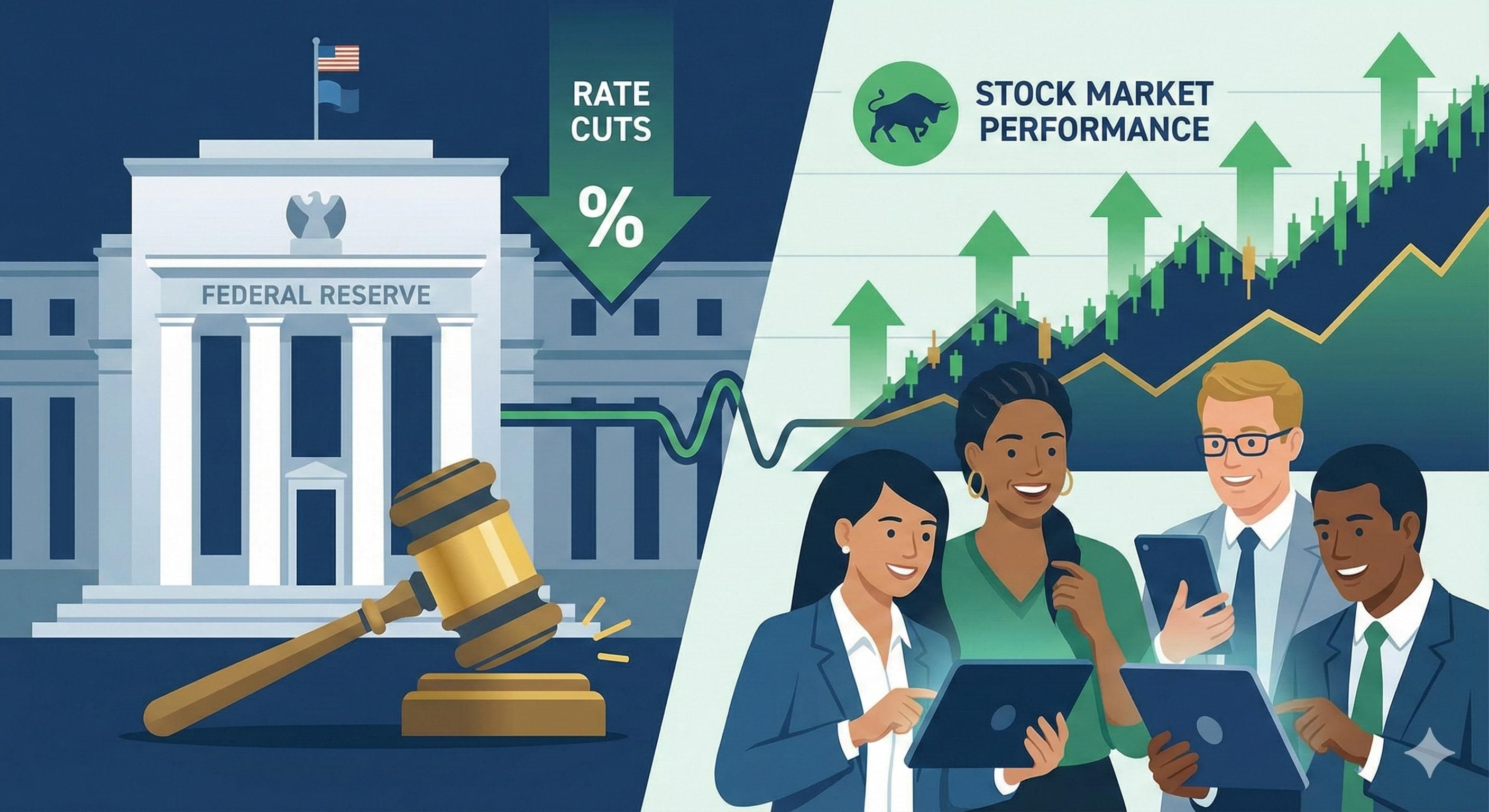
Why Interest Rate Cuts Drive Stock Market Rallies
Federal Reserve rate cuts create multiple powerful catalysts that propel stock prices higher. When the central bank lowers its benchmark interest rate, it sets off a chain reaction throughout the financial system that fundamentally alters investment dynamics.
Lower Borrowing Costs Boost Corporate Profitability
Rate reductions reduce financing costs across a broad range of companies, directly improving their bottom lines. This effect is particularly pronounced for smaller firms with higher debt loads. The Russell 2000 index, which tracks small-cap stocks, reached a record high on December 4, 2025, demonstrating how rate-sensitive companies respond to easier monetary conditions.
Corporate profit margins expand when interest expenses decline, allowing businesses to reinvest savings into growth initiatives, shareholder returns, or debt reduction. This creates a virtuous cycle that supports higher stock valuations.
Making Stocks More Attractive Than Bonds
Rate cuts reduce yields on government bonds and money market funds, fundamentally changing the risk-reward calculus for investors. When safe assets like Treasury bills offer 3% returns instead of 5%, investors naturally shift capital toward higher-yielding alternatives like equities.
This reallocation of investment dollars creates sustained buying pressure in stock markets. The phenomenon becomes self-reinforcing as more capital flows into equities, driving prices higher and attracting additional investors seeking better returns than fixed-income securities can provide.
Stimulating Economic Growth and Consumer Spending
Lower interest rates reduce costs for mortgages, auto loans, and credit cards, putting more money in consumers' pockets. This increased purchasing power stimulates economic activity, benefiting companies across multiple sectors. Businesses also find it cheaper to finance expansion, hire workers, and invest in new equipment or technology.
The economic multiplier effect of rate cuts extends beyond immediate cost savings, creating a more supportive environment for corporate earnings growth that drives stock prices higher over time.
Which Stock Market Sectors Benefit Most from Rate Cuts | Stock Market After Rate Cuts
Not all sectors respond equally to Federal Reserve rate reductions. Historical analysis reveals clear patterns about which industries outperform during rate-cutting cycles.
Real Estate and REITs Lead the Charge
Real estate investment trusts (REITs) and property developers typically emerge as the biggest winners when rates decline. Lower mortgage costs directly stimulate housing demand, while reduced borrowing expenses improve profitability for commercial real estate operators.
Homebuilders particularly benefit from drops in 30-year mortgage rates, which boost new home sales. The sector's sensitivity to financing costs makes it one of the most responsive areas of the market during easing cycles.
Technology and Growth Stocks Gain Momentum
Technology companies, especially those focused on innovation and long-term growth, see valuations rise when rates fall. This occurs because lower discount rates increase the present value of future earnings, making growth stocks more attractive.
The artificial intelligence boom adds another dimension to technology's appeal during rate cuts. While tech historically underperforms in the immediate six months following the first rate reduction, performance typically rebounds strongly over 12-month periods as investors recognize how cheaper capital accelerates innovation and expansion.
Healthcare Shows Consistent Outperformance
The healthcare and consumer staples sectors have historically emerged as top performers in the 1-, 2-, and 3-year periods following the first Fed rate cut. Healthcare benefits from demographic tailwinds, innovation in pharmaceuticals and medical technology, and relative resilience across different economic conditions.
The sector's defensive characteristics, combined with growth potential from new treatments and therapies, make healthcare stocks attractive in both strong and weak economic environments following rate cuts.
Financial Sector: A Mixed Outlook
Banks and financial institutions present a complex picture during rate-cutting cycles. While lower rates can stimulate loan demand and boost transaction volumes, they also compress net interest margins—the difference between what banks pay depositors and charge borrowers.
Regional banks with strong business lending operations may benefit from an increase in loan applications as borrowing becomes more affordable for companies looking to expand. However, financial stocks have historically performed worse than other sectors following rate cuts.
Consumer Discretionary and Small-Cap Opportunities
Smaller companies that rely on external funding see interest expenses drop heavily when rates decline, widening their profit margins. This makes small-cap stocks particularly attractive during easing cycles.
Consumer discretionary companies benefit as lower credit card and auto loan rates encourage spending on non-essential goods. Retailers, restaurants, and entertainment companies often see improved sales as consumers feel more confident about their financial situations.
Current Market Dynamics and December 2025 Rate Decision
The December 2025 FOMC meeting takes place against a backdrop of conflicting economic signals, creating unusual uncertainty among Federal Reserve officials.
Labor Market Weakness Supports Easing
Recent employment data show concerning trends that justify continued rate cuts. Private sector jobs unexpectedly fell by 32,000 in November 2025, marking the largest decline since March 2023. The unemployment rate has edged up to 4.4%, while job creation in October totaled just 12,000—far below levels needed to keep pace with labor supply growth.
These labor market indicators suggest the economy is cooling, giving the Fed room to continue its rate-cutting campaign without risking an inflation resurgence.
Inflation Concerns Create Policy Tension
Despite labor market weakness, inflation remains above the Fed's 2% target. The annual inflation rate reached 3% in September 2025, with projections suggesting it could reach 3.1% by year-end. This persistent inflation has created divisions within the FOMC about the appropriate pace of rate reductions.
Some Fed officials, including Boston Fed President Susan Collins, have expressed concerns about elevated prices and suggested maintaining current rates to ensure inflation continues declining. This internal debate has contributed to market volatility and uncertainty about the 2026 rate path.
Forward Guidance Will Shape 2026 Expectations
While the December rate cut appears likely, investors are intensely focused on the Fed's quarterly summary of economic projections, which will reveal officials' expectations for future rate moves. Current market expectations anticipate two additional quarter-point cuts in 2026, down from four cuts projected just three months earlier.
Federal Reserve Chair Jerome Powell's press conference following the December decision will be scrutinized for clues about how data-dependent policy will be in 2026 and what economic conditions might trigger pauses in the easing cycle.
Investment Strategies for a Rate-Cutting Environment
Successful investing during Federal Reserve easing cycles requires understanding both opportunities and risks while maintaining appropriate diversification.
Emphasize Quality Growth Companies
Focus on companies with strong balance sheets, consistent cash flow generation, and clear paths to profitability. The combination of lower rates and solid fundamentals creates ideal conditions for quality growth stocks to outperform.
Technology leaders with minimal debt loads and strong competitive positions benefit most, as they can leverage cheaper capital for expansion while maintaining financial flexibility.
Consider Dividend-Paying Stocks
As cash and money market yields decline, dividend-paying equities become increasingly attractive income alternatives. Mature companies with sustainable dividends offer yields that can rival bonds while providing potential for capital appreciation.
Utilities, telecommunications, and established consumer staples companies often combine reliable dividends with rate sensitivity, making them compelling options as the Fed continues to cut rates.
Maintain Sector Diversification
While certain sectors have historically outperformed during rate cuts, unexpected economic developments can quickly alter leadership dynamics. Maintaining exposure across multiple sectors provides downside protection while capturing upside from various beneficiaries of easier monetary policy.
Balance rate-sensitive sectors like real estate and small caps with defensive holdings in healthcare and consumer staples to create a resilient portfolio.
Monitor Economic Indicators Closely
The effectiveness of rate cuts depends heavily on underlying economic conditions. Rate reductions during slowdowns typically support markets more effectively than cuts during recessions accompanied by earnings declines.
Pay attention to employment trends, corporate earnings reports, and inflation data to gauge whether the economy is achieving a "soft landing" that benefits stocks or facing more serious challenges that could limit equity gains despite lower rates.
Frequently Asked Questions
Q: How quickly do stocks react to Federal Reserve rate cuts?
A: Stock market reactions to rate cuts occur in multiple phases. Initial responses happen immediately as expectations shift, often before the actual cut occurs. The Russell 2000's December 2025 rally demonstrated this, with small-cap stocks surging as rate-cut odds increased. However, sustained sector performance typically emerges over 6-12-month periods as lower rates work through the economy. Volatility often increases around FOMC announcements before settling as uncertainty resolves.
Q: How do rate cuts affect the stock market?
A: Rate cuts typically support stock prices, but context matters significantly. Cuts during economic slowdowns with stable earnings generally boost markets effectively. However, aggressive rate reductions in response to financial crises or severe recessions may not prevent stock declines if corporate earnings collapse. The current environment—with rate cuts occurring amid a cooling but not collapsing economy—tends to be favorable for equities.
Q: Which individual stocks benefit most from lower interest rates?
A: Companies with significant debt loads, strong growth potential, and sensitivity to economic conditions benefit most. Examples include homebuilders like D.R. Horton, technology growth companies needing capital for expansion, regional banks that can increase lending volumes, and REITs with large property portfolios. Small-cap companies generally outperform large-cap companies during rate-cutting cycles due to their greater reliance on external financing.
Q: How should investors adjust portfolios ahead of rate cuts?
A: Consider gradually increasing exposure to rate-sensitive sectors like real estate, small-caps, and technology growth stocks while maintaining core holdings in quality large-caps and defensive sectors. Avoid making dramatic all-or-nothing portfolio shifts, as timing perfect entries is difficult. Instead, rebalance incrementally as rate cut expectations crystallize, ensuring sufficient diversification to handle unexpected economic developments.
Q: What risks should investors watch during rate-cutting cycles?
A: Key risks include inflation resurging and forcing the Fed to pause or reverse cuts, economic weakness proving worse than anticipated and causing earnings disappointments, and valuations becoming stretched in high-momentum sectors. Market concentration in AI and mega-cap technology stocks also poses risks, as sharp corrections in these names can overwhelm benefits from rate cuts in smaller segments of the market.
This article provides general information and should not be considered personalized investment advice. Consult with a qualified financial advisor before making investment decisions based on your individual circumstances and goals.

Pages Related to #impact of fed rate cuts on stock market
- 3 trends in Commercial Real Estate

- Non institutional lenders are taking the center stage

- Real Estate Investing Basics: 2 Ways of Real Estate Investment

- Are REITs safe investment? REIT risks explained. Mortgage REIT risks.

- Investing in REITs vs Rental Property. Comparison Between Direct Real Estate Investment vs REITs.

- [closed] CMF. Cedar Multifamily Fund
![[closed] CMF. Cedar Multifamily Fund](https://d2sv4n3pfes7l9.cloudfront.net/file_paperfree_144_2020-8-21-19-57-p_pf-avatar.jpg)
- What is a DST 1031 exchange in Real Estate Investing?

- EB-5 for Tech Entrepreneurs: Immigration Program for Startup Founders | Paperfree

Popular Pages
Private Real Estate Funds - Investments to Drive Income and Capital Growth
Book a Free Complimentary Call
real estate investing Investment Visa USA Investment Magazine Private Real Estate Funds real estate funds