How Much Does an Airline Make Per Flight? The Economics Behind Every Takeoff
McKinsey analyzes the revenue, costs, and minimal profit margins of a typical Boeing 787 flight from London to New York.last updated Tuesday, September 22, 2026
#how much do airlines make per flight #Airline Profit Per Flight
| | by Sidra Jabeen | Content Manager, Paperfree Magazine |
QUICK LINKS
ad
Get Access to Real Estate Investment Opportunities
The next time you settle into your seat at 35,000 feet, consider this: the airline carrying you across the Atlantic may pocket less than you'd spend on dinner after you land. A recent breakdown by McKinsey & Company reveals just how razor-thin the margins are in commercial aviation — even on one of the world's most profitable routes.
Breaking Down a London-to-New York Flight
McKinsey examined the economics of a typical one-way Boeing 787 flight from London to New York — a premium transatlantic route with strong demand. Here's what the numbers look like.
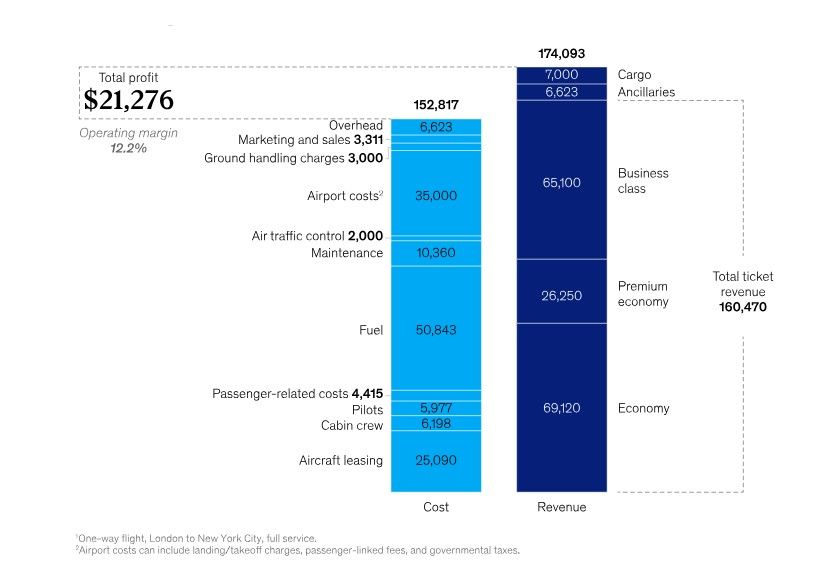
Revenue: $174,093
Ticket sales make up the bulk at $160,470, spread across three cabin classes:
- Economy — 192 seats at 90% occupancy, sold at $400 each, generating $69,120.
- Premium Economy — 35 seats at 75% occupancy, sold at $1,000 each, generating $26,250.
- Business Class — 31 seats at 70% occupancy, sold at $3,000 each, generating $65,100.
What's striking is how business class — with less than a sixth of the seats — contributes over 40% of ticket revenue. That dynamic is central to how long-haul aviation stays financially viable.
But tickets are only part of the picture. An additional $13,623 comes from ancillary sources: $6,623 from extras like checked baggage, seat selection, and in-flight purchases, plus $7,000 from cargo. That last figure is worth pausing on — half the world's air freight flies in the belly of passenger jets, making cargo a quietly essential revenue stream.
Costs: $152,817
Now for the other side of the ledger. Running an eight-hour transatlantic flight is extraordinarily expensive. Here's where the money goes:
| Cost Category | Amount |
|---|---|
| Fuel | $50,843 |
| Airport costs | $35,000 |
| Aircraft lease | $25,090 |
| Maintenance | $10,360 |
| Cabin crew | $6,198 |
| Pilots | $5,977 |
| Overheads | $6,623 |
| Passenger-related costs | $4,415 |
| Marketing and sales | $3,311 |
| Ground handling charges | $3,000 |
| Air traffic control | $2,000 |
| Total | $152,817 |
Fuel alone accounts for a third of all costs. Airport fees—covering landing charges, takeoff fees, passenger-linked taxes, and government levies—represent the second-largest expense. Together, those two line items account for more than half of the flight's total revenue.
The Bottom Line: $21,276 in Profit
That leaves an operating profit of $21,276 a 12.2% margin on a flight carrying over 250 passengers across the Atlantic Ocean.
Airline Profit Per Flight: The Bigger Picture Is Even Tighter
McKinsey is quick to add context: London–New York is a premium route with favorable economics. In the real world, margins get compressed by rising fuel costs, delays, connecting passenger logistics, and less profitable routes. The average operating margin across the global airline industry sits at just 3–6%.
For perspective, a typical software company operates at 20–30% margins. Even grocery chains — often cited as a low-margin business — can match or exceed airline profitability.
What This Means for Business and Investment
For anyone evaluating the airline industry — whether as an investor, a supplier, or a business traveler negotiating corporate contracts — these numbers carry real implications:
- Scale is survival. With margins this thin, airlines need enormous volume to generate meaningful returns. A single flight's profit might cover one employee's weekly salary.
- Ancillary revenue is strategic, not incidental. The $13,623 from baggage fees, seat upgrades, and cargo represents nearly two-thirds of the flight's total profit. Airlines that optimize these streams have a meaningful edge.
- Fuel exposure is existential. At $50,843 per flight, even modest swings in jet fuel prices can flip a profitable route into a loss-maker overnight. Hedging strategies and fleet fuel efficiency aren't operational details — they're core financial strategy.
- Business class subsidizes the operation. Thirty-one business class seats generated almost as much revenue as 192 economy seats. The competition for premium passengers explains why airlines invest heavily in lie-flat seats, lounge access, and loyalty programs.
The Takeaway
The airline industry moves billions of people and tons of cargo across the globe every year, operating one of the most capital-intensive, cost-sensitive businesses in existence. The fact that a full transatlantic 787 generates roughly $21,000 in profit — before accounting for any delays, disruptions, or downturns — is a testament to both the fragility and the resilience of modern aviation.
This article is based on analysis originally published by McKinsey & Company. For the full breakdown and additional insights, visit McKinsey's original research.
© Paperfree.com — Simplifying business knowledge for smarter decisions.

Pages Related to #how much do airlines make per flight
Popular Pages
Private Real Estate Funds - Investments to Drive Income and Capital Growth
Book a Free Complimentary Call
real estate investing Investment Visa USA Investment Magazine Private Real Estate Funds real estate funds