USCIS Cuts EAD Validity to 18 Months: What EB-5 Investors Must Know Now
USCIS reduces EAD validity from 5 years to 18 months for EB-5 investors. Learn critical impacts, renewal strategies & protection tips.last updated Friday, January 2, 2026
#USCIS EAD validity #Uscis ead 18 months
| | by Sidra Jabeen | Content Manager, Paperfree Magazine |
QUICK LINKS
AD
Get Access to EB 5 Investment Visa Resources
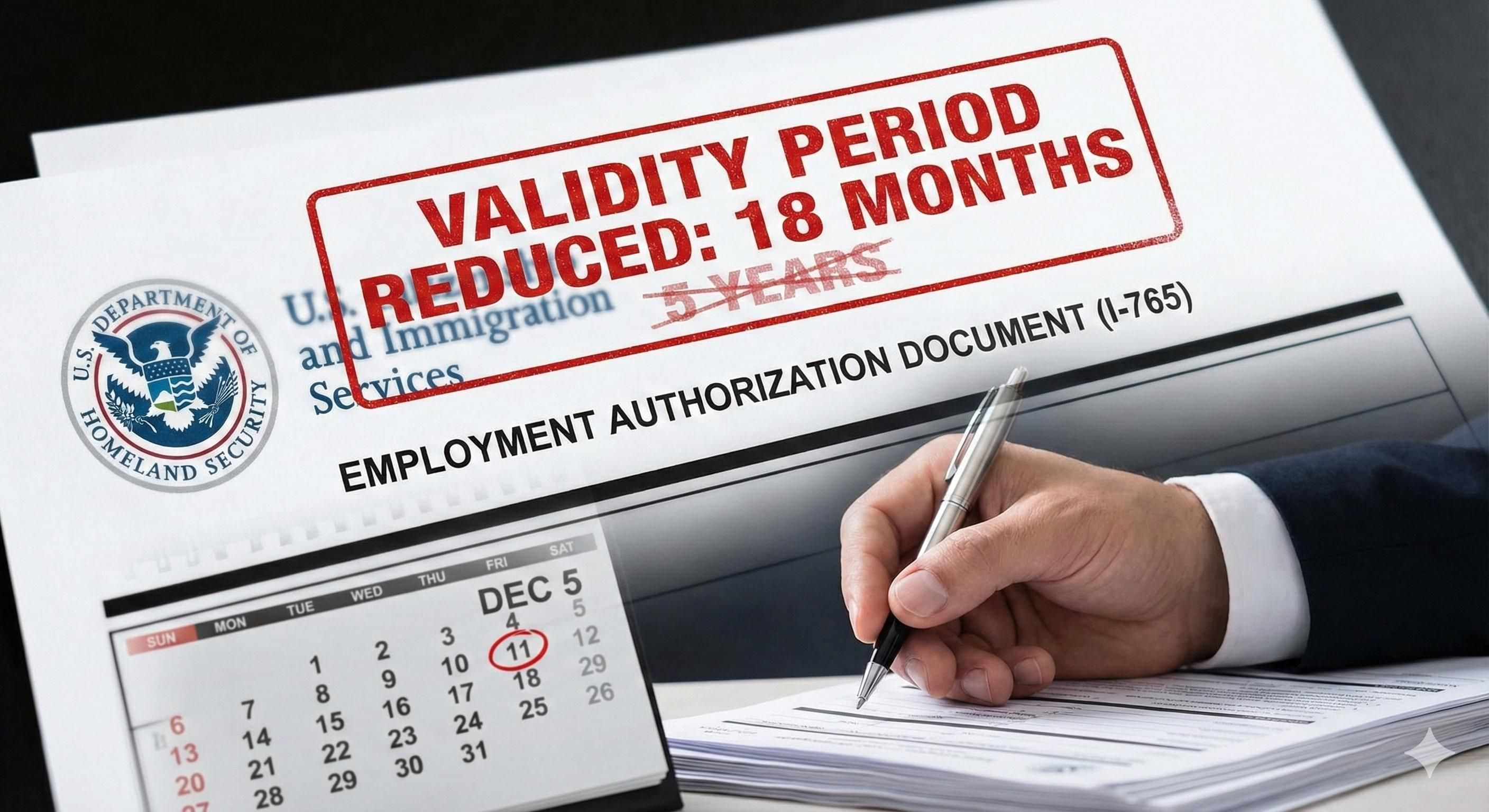
In a significant policy shift effective December 5, 2025, U.S. Citizenship and Immigration Services has dramatically reduced Employment Authorization Document validity periods from five years to just 18 months for adjustment of status applicants—a change that directly affects thousands of EB-5 investors currently pursuing permanent residency in the United States.
This eb5 ead validity 70% reduction in work authorization validity represents one of the most consequential immigration policy changes in recent years, creating new financial burdens, increased administrative complexity, and heightened risks of employment gaps for foreign investors who have already committed substantial capital to U.S. economic development through the EB-5 Immigrant Investor Program.
Understanding the Policy Change | USCIS EAD 18 Months
The new USCIS EAD validity directive applies to both initial and renewal Employment Authorization Documents for individuals with pending adjustment of status applications under Immigration and Nationality Act Section 245. According to USCIS, the shortened validity period aims to enable more frequent vetting and security screenings of foreign nationals seeking work authorization in the United States.
Who Is Affected?
The 18-month EAD limitation impacts several immigration categories, with particular significance for EB-5 program participants:
- EB-5 Regional Center Investors with pending Form I-526E petitions who have filed concurrent Form I-485 applications
- Direct EB-5 Investors pursuing standalone investment pathways with adjustment of status applications
- Family members of EB-5 principal investors, including spouses and unmarried children under 21
- Other adjustment applicants, including refugees, asylees, and those with pending asylum applications
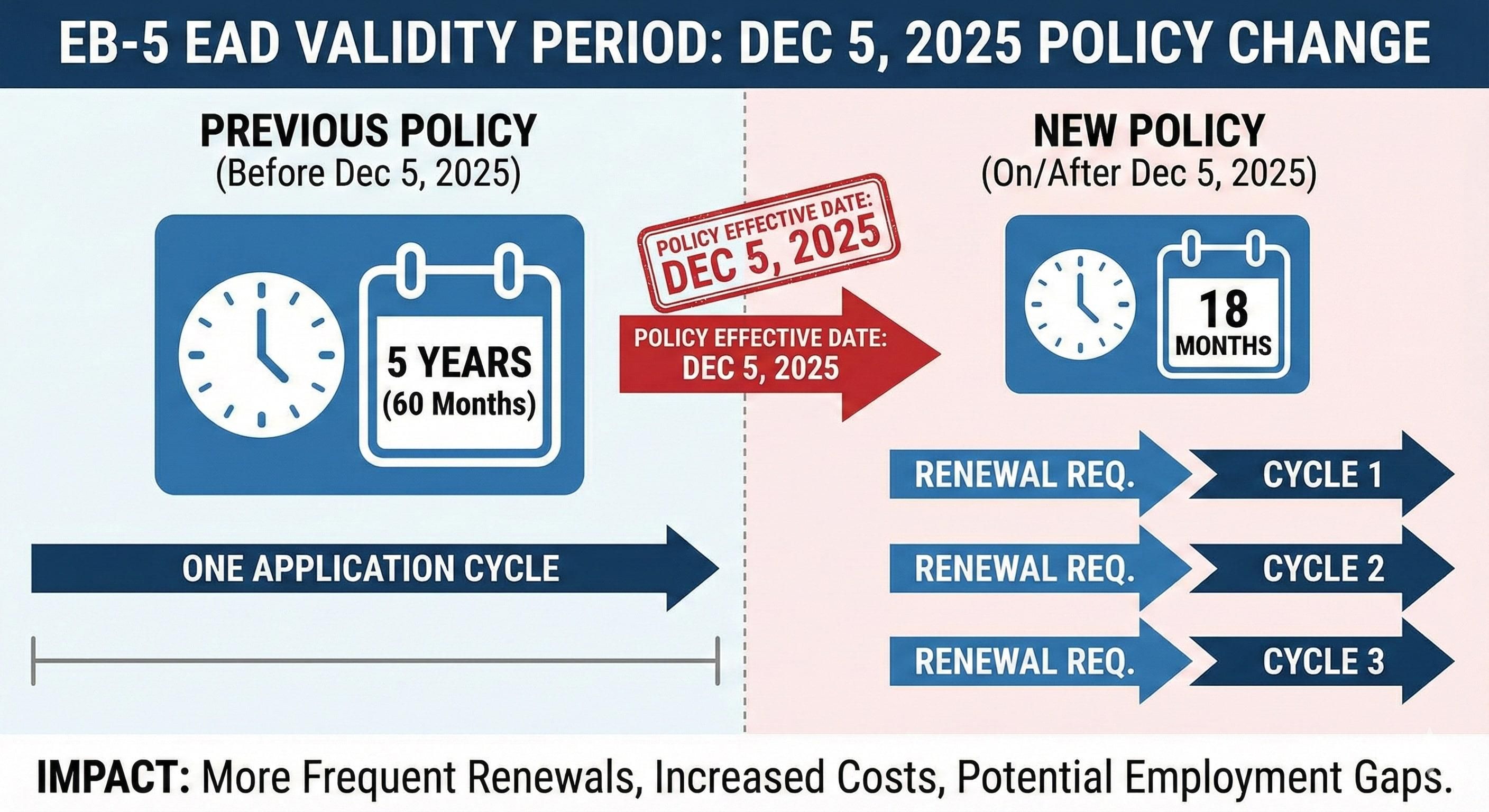
Crucially, this policy affects all EAD applications pending as of December 5, 2025, as well as any applications filed on or after that date. Previously approved five-year EADs remain valid until their printed expiration dates.
Critical Implications for EB-5 Investors | USCIS EAD News
The reduction from five years to 18 months creates multiple challenges uniquely impactful to the EB-5 investor community, who already navigate complex financial commitments and extended processing timelines.
Financial Burden Amplification
EB-5 investors now face significantly increased costs throughout their immigration journey. Where a single EAD application previously covered up to five years, investors must now file renewal applications every 18 months. With current Form I-765 filing fees and potential additional costs for legal representation, the cumulative financial impact over a typical EB-5 timeline can reach several thousand dollars.
Consider an EB-5 investor whose adjustment of status takes four years to process—a realistic timeframe given current USCIS workloads. Under the previous system, this investor would need just one EAD renewal. Under the new policy, the same investor requires three renewals, tripling application costs and legal fees.
Employment Authorization Gaps
Perhaps the most concerning risk involves potential gaps in work authorization. Current USCIS processing times for Form I-765 applications range from four to seven months, though delays can extend beyond this window during periods of high application volume.
The shorter 18-month validity period significantly reduces the buffer time available to applicants. Immigration attorneys emphasize that even with timely filing—permitted up to 180 days before EAD expiration—processing delays can leave workers without valid authorization. This creates serious consequences for EB-5 investors who have established careers, businesses, or employment relationships in the United States.
Unlike previous periods when automatic EAD extensions provided safety nets, recent policy eliminations have removed these protections. A lapsed EAD immediately terminates work authorization, potentially jeopardizing employment and creating compliance issues for employers.
Administrative Complexity
The policy change substantially increases administrative burden for EB-5 investors and their families. Each renewal application requires:
- Complete Form I-765 submission with updated documentation.
- Current photographs meeting USCIS specifications.
- Filing fees and payment processing.
- Potential biometrics appointments.
- Legal review and preparation time.
- Employer notification and I-9 reverification processes.
For EB-5 families with multiple derivative beneficiaries, this administrative burden multiplies. A family of four now manages renewal cycles for four separate EAD applications every 18 months throughout their adjustment period.
Impact on Business Operations
EB-5 investors who have established businesses in the United States face unique challenges. Many regional center investors actively participate in U.S. business operations beyond their investment requirements, while direct EB-5 investors often directly manage their new commercial enterprises.
Shorter EAD validity periods create uncertainty for:
- Business planning and expansion decisions requiring multi-year operational continuity.
- Professional licensing in fields requiring continuous work authorization.
- Banking and credit relationships where work authorization affects loan terms.
- Commercial lease agreements and other long-term business commitments.
- Employee recruitment and retention when the investor serves in management roles.
Strategic Response: Essential Actions for EB-5 Investors
Despite these challenges, EB-5 investors can implement strategic measures to minimize disruption and maintain continuous work authorization throughout their green card journey.
Early Renewal Filing
The single most important protective measure involves filing EAD renewals at the earliest permissible date. USCIS permits Form I-765 renewal applications up to 180 days (six months) before current EAD expiration. Given processing timelines often exceeding six months, investors should mark their calendars and initiate renewal processes immediately when eligible.
Working with experienced immigration counsel becomes even more critical under the new regime. Attorneys can establish systematic reminder systems, prepare renewal applications in advance, and respond quickly to any Requests for Evidence that might extend processing times.
Concurrent Filing Advantages
For prospective EB-5 investors not yet in the United States or planning their applications, understanding concurrent filing benefits remains essential. The EB-5 Reform and Integrity Act of 2022 permits eligible investors to file Form I-526E (or I-526) simultaneously with Form I-485 adjustment of status applications when visa numbers are current.
Concurrent filing enables EB-5 investors already in the United States on valid non-immigrant visas to:
- Maintain lawful status based on pending I-485 applications
- Obtain initial EAD and Advance Parole (travel) authorization within three to four months
- Begin working and traveling while awaiting I-526E approval
- Avoid visa stamp requirements at U.S. consulates abroad
Even under the new 18-month validity limitation, concurrent filing provides faster initial work authorization than sequential filing processes. For investors from countries without visa retrogression—currently including most nations for reserved category EB-5 visas—concurrent filing remains highly advantageous.
Priority Processing Opportunities
EB-5 investors should carefully evaluate project selection with processing considerations in mind. Rural Targeted Employment Area (TEA) projects receive priority I-526E processing from USCIS, with recent approval timelines averaging six months compared to longer periods for non-rural projects.
Faster I-526E approval accelerates the entire immigration timeline, reducing the total number of EAD renewals required before receiving conditional permanent residence. An investor in a rural TEA project who receives I-526E approval within six months and subsequent I-485 approval within 12 months may need only one or two EAD renewals total, compared to multiple renewals over extended processing periods.
Documentation Excellence
Each EAD renewal application must meet USCIS standards for completeness and accuracy. Incomplete or incorrect applications result in rejections, delays, and potential gaps in work authorization. EB-5 investors should maintain comprehensive files including:
- Current passport copies and biographical documentation.
- Prior EAD cards and approval notices.
- Evidence of pending I-485 applications.
- Current photographs meeting USCIS specifications.
- Receipt numbers and case status information.
- Complete addresses and employment history.
Working with immigration professionals ensures applications meet technical requirements and include all necessary supporting evidence, minimizing the risk of processing delays.
Employer Communication
For EB-5 investors employed by U.S. companies (whether their own businesses or other employers), maintaining transparent communication about work authorization timelines is essential. Employers must reverify work authorization when EADs expire, and proactive communication helps prevent compliance gaps.
Human resources departments should receive timely notification about:
- Upcoming EAD expiration dates.
- Renewal application filing dates and receipt numbers.
- Expected processing timelines.
- Contingency plans if processing delays occur.
This transparency protects both investors and employers from inadvertent compliance violations that could jeopardize employment relationships or create liability issues.
The Broader Context: EB-5 Program Considerations
While the EAD validity reduction creates new challenges, the EB-5 program continues offering substantial advantages for foreign investors seeking U.S. permanent residency. Understanding how this policy change fits within the broader EB-5 landscape helps investors maintain perspective and make informed decisions.
Continuing Program Benefits
Despite shorter EAD validity, the EB-5 program provides benefits unavailable through other immigration pathways:
- Path to permanent residence for investors and immediate family members.
- No employer sponsorship required, unlike H-1B or L-1 visa categories.
- Flexibility in employment and location once work authorization is secured.
- Lower investment threshold of $800,000 for TEA projects compared to $1,050,000 standard investment.
- Reserved visa categories reducing or eliminating retrogression for many investors.
- Priority processing for rural TEA investments.
- Concurrent filing availability for investors already in the United States.
Investment Timeline Realities
EB-5 investors should approach the program with realistic expectations about timelines. While rural TEA projects with priority processing achieve relatively quick I-526E approvals, the complete journey to conditional permanent residence typically spans 12 to 24 months from filing, with removal of conditions following two years later.
The 18-month EAD validity reduction means most investors will experience at least one renewal cycle, and possibly several, before receiving green cards. Planning for this reality—financially and administratively—helps investors avoid surprises and maintain continuous work authorization.
Regional Center Selection
Choosing the right EB-5 regional center and project becomes even more critical under the new policy. Investors should evaluate not only investment safety and job creation reliability but also factors affecting immigration timeline:
- USCIS approval track record for the regional center and specific projects.
- I-526E approval rates and processing speeds.
- Project type (rural TEA for priority processing).
- Job creation methodology and surplus job creation buffer.
- Legal and administrative support provided to investors.
Regional centers with established reputations, transparent operations, and strong USCIS relationships can help minimize processing delays that would extend EAD renewal requirements.
Looking Forward: Policy Stability and Advocacy
The December 2025 EAD validity reduction represents the latest in a series of immigration policy changes affecting employment-based visa holders. EB-5 investors should remain informed about potential future developments and advocacy efforts within the investor immigration community.
Industry Response
Immigration attorneys and EB-5 industry organizations have expressed concern about the policy's impact on lawful immigrants contributing to U.S. economic development. Legal experts warn that shortened validity periods, combined with extended processing times and recent elimination of automatic extensions, create unnecessary hardship for applicants who have invested significantly in the United States.
Several immigration law firms have indicated they may challenge aspects of the policy through administrative or legal channels, arguing that the change contradicts congressional intent to facilitate investment-based immigration and job creation.
Congressional Awareness
The EB-5 program operates under periodic congressional authorization, with the current Regional Center Program authorized through September 30, 2027. Industry advocates are working to ensure congressional leaders understand how administrative policy changes affect investor confidence and program effectiveness.
Future legislation could address EAD validity periods, processing timelines, or related issues affecting employment-based visa holders. EB-5 investors should stay connected with industry organizations and immigration counsel to monitor developments.
Regional Center Program Reauthorization
As the September 2026 grandfathering deadline approaches, EB-5 investors face important strategic decisions. Any investor who files Form I-526E before September 30, 2026, gains protection for adjudication under current law even if the Regional Center Program lapses or changes after 2027.
This deadline, combined with the EAD validity reduction, creates urgency for prospective investors considering the EB-5 pathway. Filing before the deadline provides long-term certainty regardless of future legislative changes.
Practical Recommendations: Your Action Plan
Based on the policy change and its implications, EB-5 investors should take the following concrete steps:
For Current EB-5 Investors with Pending Adjustments:
- Calculate your first renewal date (EAD expiration date minus 180 days) and set multiple calendar reminders.
- Review your current EAD for expiration date and prepare renewal documentation well in advance.
- Consult immigration counsel to establish systematic renewal processes and confirm no case-specific complications exist.
- Notify your employer about the shortened validity period and renewal schedule.
- Budget for multiple renewal cycles including filing fees and legal costs throughout your adjustment period.
- Monitor case processing times on the USCIS website to anticipate potential delays.
- Maintain comprehensive immigration files with all documentation readily accessible.
For Prospective EB-5 Investors:
- Evaluate concurrent filing eligibility if you're already in the U.S. on a valid non-immigrant visa.
- Prioritize rural TEA projects for faster I-526E processing and fewer required EAD renewals.
- Select regional centers with proven track records for quick adjudications.
- Plan investment timing to file before the September 2026 grandfathering deadline.
- Factor additional EAD costs into your overall EB-5 budget and financial planning.
- Engage experienced counsel early to structure your case for optimal processing speed.
- Understand the complete timeline including multiple EAD renewals before permanent residence.
For All EB-5 Stakeholders:
- Stay informed about policy developments affecting employment authorization.
- Maintain realistic expectations about processing timelines and administrative requirements.
- Build relationships with experienced immigration professionals familiar with EB-5 complexities.
- Document everything related to your investment, immigration case, and work authorization.
- Support advocacy efforts for reasonable processing times and administrative procedures.
Book Your Free Consultation with Paperfree EB-5 Visa Experts. Get Personalized Advice and Investment Plans. Book Your Free Consultation Today!

Conclusion: Navigating New Realities
The reduction of EAD validity from five years to 18 months represents a significant policy shift requiring adaptive strategies from EB-5 investors. While the change creates additional financial costs, administrative burdens, and potential risks of authorization gaps, informed investors working with experienced counsel can successfully navigate these challenges.
The EB-5 program continues offering powerful advantages for foreign nationals seeking U.S. permanent residency through investment. The path to a green card now requires more frequent renewals and careful timing, but the fundamental benefits—permanent residence for investors and families, employment flexibility, and eventual U.S. citizenship eligibility—remain unchanged.
Success under the new regime demands proactive planning, early action on renewals, strategic project selection, and professional guidance throughout the process. EB-5 investors who understand the policy implications and implement protective measures can maintain continuous work authorization while pursuing their immigration goals.
As the EB-5 industry adapts to evolving administrative requirements, staying connected with experienced regional centers, immigration attorneys, and industry organizations provides essential support for navigating both current challenges and future developments.
The journey to permanent residence through EB-5 investment requires patience, diligence, and adaptability. With proper preparation and expert guidance, investors can successfully manage the new EAD validity requirements while building their American future.
About PaperFree EB-5 Investors Magazine
PaperFree EB-5 Investors Magazine provides authoritative analysis, expert insights, and practical guidance for foreign investors navigating the EB-5 Immigrant Investor Program. Our coverage helps investors make informed decisions about project selection, immigration strategy, and investment protection throughout their journey to U.S. permanent residency.
For more information about the EB-5 program and investment opportunities, visit paperfree.com/en/eb5.
Disclaimer: This article provides general information about USCIS policy changes and their implications for EB-5 investors. It does not constitute legal advice. EB-5 investors should consult qualified immigration attorneys for guidance specific to their individual circumstances and cases.

Pages Related to #USCIS EAD validity
- EB5 Investment Visa Guide 2025

- Best EB5 Regional Center List | American EB5 Regional Center

- Paperfree Investment Visa EB-5 Program is Your Your Clear Path to Green Card USA

- US Immigration: Big increase in EB–5 visa fees proposed

- EB 5 Visa Requirements 2026 ( updated ), A Guide to Eligibility for U.S. Investment-Based Residency

- EB 5 investment amount and EB-5 Visa Cost 2025-2026
- 15th Annual IIUSA EB-5 Industry Forum Houston, TX : Strategic Insights for 2025

- EB5 Visa Interview Questions For Seamless Immigration

Popular Page
Benefits of the EB-5 Visa Program| A Comprehensive Guide
Book a Free Complimentary Call
real estate investing Investment Visa USA Investment Magazine Private Real Estate Funds real estate funds