Why Dubai and UAE Investors Are Turning to the EB-5 Visa Amid Regional Instability
How the Iran-Israel-U.S. conflict is reshaping residency planning for high-net-worth families in Dubai and across the UAE.last updated Thursday, March 19, 2026
#eb 5 visa dubai #eb 5 investor visa from dubai
| | by Sidra Jabeen | Content Manager, Paperfree Magazine |
QUICK LINKS
AD
Get Access to EB 5 Investment Visa Resources
The ongoing Iran-Israel conflict, coupled with rising tensions involving the United States, has set off alarm bells for investors in the Middle East, particularly in cities like Dubai and throughout the UAE. These geopolitical uncertainties have prompted high-net-worth individuals and business owners to reassess their financial and residency plans, with many seeking ways to protect their wealth and secure a more stable future. As regional volatility increases, the EB5 visa program has emerged as a strategic solution, offering a secure pathway to U.S. residency through investment.
This article examines how the Iran-Israel conflict is affecting Dubai and UAE investors, highlighting the growing concerns over regional instability. We will explore how the EB-5 visa enables investors to protect their assets, ensure long-term stability, and diversify their investments amid ongoing geopolitical risks.
The Shift in Sentiment Among Gulf Investors
For high-net-worth individuals in the Gulf, geopolitical uncertainty is no longer a distant risk — it is a present reality reshaping investment and residency decisions.
Dubai has spent two decades building its reputation as the Middle East's most resilient financial hub. Investors from across the region, South Asia, and Europe have parked capital here precisely because of its stability, its world-class infrastructure, and its distance — both geographic and political — from regional conflicts.
That calculus is changing.
The escalating Iran-Israel conflict, a series of direct military exchanges between Iran and Israel in 2024, U.S. military involvement in the region, and ongoing threats to the Strait of Hormuz have introduced a level of uncertainty that even Dubai's most optimistic investors can no longer ignore. For the first time in years, high-net-worth individuals (HNWIs) in the UAE are not simply asking how to grow their wealth — they are asking how to protect it.
The answer, for a growing number of them, is the U.S. EB-5 Immigrant Investor Visa.
What Is Driving the Urgency?
The Iran-Israel Escalation
The conflict between Iran and Israel has moved beyond proxy warfare and rhetoric. Iran's unprecedented direct missile and drone attacks on Israeli territory, and Israel's retaliatory strikes, represent a qualitative shift in Middle East security dynamics. For UAE residents, the proximity of this conflict is not abstract — Iran sits just 150 kilometers across the water from Dubai's coastline.
The Strait of Hormuz Risk
Approximately 20% of the world's oil passes through the Strait of Hormuz, a narrow waterway that borders the UAE's territorial waters. Any military action that closes or disrupts the Strait would send shockwaves through the UAE economy — affecting energy exports, trade logistics, and investor confidence almost immediately.
The UAE's Delicate Position
The UAE has skillfully maintained relationships with both the United States and Iran — a balancing act that has served it well commercially. But as U.S.-Iran tensions rise, that neutrality becomes harder to sustain. The presence of major U.S. military assets at Al Dhafra Air Base, combined with the UAE's Abraham Accords normalization with Israel, means the country could be drawn into a wider regional confrontation, whether it seeks involvement or not.
For investors, this is not fear-mongering — it is risk management. And their response has been methodical: seek a second residency or citizenship in a stable, economically powerful country before an emergency forces the decision.
Why the EB-5 Visa Makes Strategic Sense for Dubai Investors
The EB-5 Immigrant Investor Program, administered by U.S. Citizenship and Immigration Services (USCIS), grants U.S. permanent residency (a green card) to foreign nationals who make a qualifying investment in the United States that creates or preserves at least 10 full-time jobs for U.S. workers.
For Dubai investors, it offers something that few other residency programs can match: entry into the world's largest, most liquid, and most institutionally stable economy — with full legal residency rights for the entire immediate family.
Investment Thresholds
| Investment Type | Minimum Amount |
|---|---|
| Targeted Employment Area (TEA) — rural or high-unemployment | $800,000 |
| Standard investment outside a TEA | $1,050,000 |
These are not donations or fees — they are investments into U.S.-based businesses or USCIS-approved regional center projects, with the potential to generate returns.
Five Reasons Dubai Investors Are Choosing the EB-5 Route
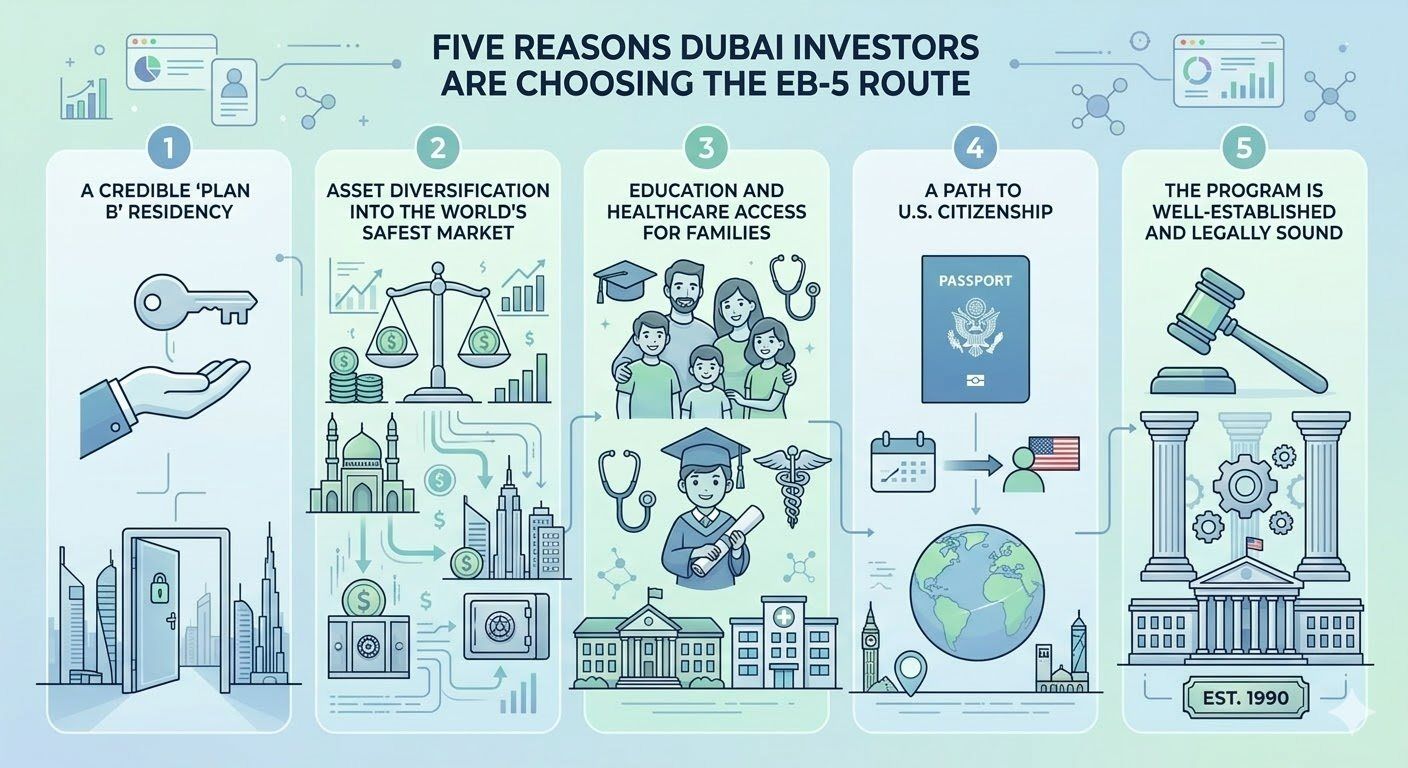
1. A Credible "Plan B" Residency
For most UAE-based investors, the EB-5 is not an exit strategy — it is insurance. They are not planning to leave Dubai tomorrow. They are ensuring that if the regional situation deteriorates sharply, they have a legal right to live and work in the United States without scrambling for a visa under pressure.
U.S. permanent residency is one of the most valuable documents in the world. It provides the holder — and their spouse and children under 21 — the right to live, work, and study anywhere in the United States indefinitely.
2. Asset Diversification Into the World's Safest Market
Regional uncertainty poses a real threat to concentration risk. Investors with the majority of their wealth in UAE real estate, Gulf equities, or regional business interests are exposed to a single geopolitical shock.
The EB-5 investment moves a meaningful portion of capital into U.S. dollar-denominated assets inside the U.S. legal and financial system — one of the most robust frameworks for investor protection in the world.
3. Education and Healthcare Access for Families
Many Dubai investors cite their children's futures as the primary driver of their decision. An EB-5 green card gives children access to U.S. universities at in-state tuition rates, eligibility for federal financial aid, and the ability to work in the U.S. after graduation without sponsorship constraints. Access to the U.S. healthcare system is a further consideration for families with long-term planning horizons.
4. A Path to U.S. Citizenship
After five years of permanent residency — or three years if married to a U.S. citizen — EB-5 green card holders are eligible to apply for U.S. citizenship. This opens the world's most powerful passport, with visa-free or visa-on-arrival access to over 186 countries.
5. The Program Is Well-Established and Legally Sound
Unlike some citizenship-by-investment programs that face political pressure or sudden changes, the EB-5 program was created by the U.S. Congress in 1990 and has issued tens of thousands of green cards. The EB-5 Reform and Integrity Act of 2022 introduced significant improvements to investor protections and program oversight, making it more transparent and secure than at any point in its history.
The EB-5 Process: What Dubai Investors Need to Know
The process has four main stages, though timelines vary depending on the investor's country of birth and the type of investment chosen.
Stage 1 — File Form I-526E (Immigrant Petition). The investor submits a petition to USCIS demonstrating that the investment meets EB-5 requirements. This includes source-of-funds documentation, which for UAE investors typically involves business ownership records, property valuations, or inheritance documentation.
Stage 2 — Visa Issuance or Adjustment of Status Once the petition is approved and a visa number is available, investors outside the U.S. apply through a U.S. consulate (consular processing). Investors already in the U.S. on a valid visa can adjust status domestically.
Stage 3 — Conditional Green Card: The investor and qualifying family members receive a two-year conditional green card.
Stage 4 — Remove Conditions (Form I-829) After 2 years, the investor demonstrates that the investment was sustained and that the required jobs were created, thereby converting the conditional green card into a permanent one.
Typical total timeline: 2.5 to 5+ years, depending on country of birth. Indian and Chinese nationals face longer waits due to high demand from those countries. UAE nationals and most Arab nationals currently face no significant backlog.
EB-5 vs. the Gold Card: What UAE Investors Should Know
A question rising sharply among UAE investors is how the EB-5 compares to the so-called "Gold Card" — a proposed $5 million U.S. residency program floated in 2025. The key differences matter:
- The EB-5 is an established, Congressionally-authorized program with a 35-year track record. The investment minimum starts at $800,000.
- The Gold Card remains a proposal as of mid-2025, with no formal legislation passed. At $5 million, it targets the ultra-HNW segment and requires no job creation.
For most UAE investors, the EB-5 remains the practical, proven route. The Gold Card is worth monitoring, but not yet actionable.
Who Is This For? The Dubai Investor Profile
The EB-5 program is best suited for UAE-based investors who:
- Hold net assets of $2 million or above (to comfortably fund the investment plus professional and legal fees)
- Have children approaching university age in the next 5–10 years
- Own businesses or real estate in the Gulf and want geographic diversification
- Hold passports that offer limited global mobility and see U.S. residency as a long-term upgrade
- Are in the early stages of succession planning and want to give the next generation a U.S. base
Take the First Step
At Paperfree, we work with investors across the UAE and wider Gulf region to navigate the EB-5 process from source-of-funds preparation through to green card approval. Our team understands the specific documentation landscape for UAE-based investors, the nuances of regional center selection, and the realities of investing across time zones and legal systems.
We offer a free, no-obligation consultation to help you assess whether the EB-5 is the right fit for your circumstances.
This article is for informational purposes only and does not constitute legal or investment advice. Readers should consult a qualified U.S. immigration attorney before making any investment or visa-related decisions.
Paperfree is an immigration and investment advisory platform, not a news organization. The geopolitical context referenced in this article is drawn from publicly available information for illustrative purposes only. We do not report on, verify, or update current events in real time. For the latest news on regional developments, please consult established news sources.

Pages Related to #eb 5 visa dubai
- EB5 Investment Visa Guide 2025

- Paperfree Investment Visa EB-5 Program is Your Your Clear Path to Green Card USA

- US Immigration: Big increase in EB–5 visa fees proposed

- EB5 Processing Time: A Journey Towards Green Card 2026 | Paperfree.com
- July 2025 Visa Bulletin: EB-5 Program & EB-5 Investment Visa Updates for Investors

- EB-5 processing time by country updated 2026

- EB-5 for Tech Entrepreneurs: Immigration Program for Startup Founders | Paperfree

- EB-5 Investment Protection: How Experienced Developers Safeguard Your Capital | Paperfree

Popular Page
Benefits of the EB-5 Visa Program| A Comprehensive Guide
Book a Free Complimentary Call
real estate investing Investment Visa USA Investment Magazine Private Real Estate Funds real estate funds