| | by Sidra Jabeen | Content Manager, Paperfree Magazine |
President Trump's Gold Card Proposal: Impact on the EB-5 Visa Program
How Trump's Gold Card Visa Proposal Could Reshape Investment Immigration and Impact the EB-5 Programlast updated Sunday, November 30, 2025
#gold card trump #eb-5 program
AD
Get Access to EB 5 Visa Investment Projects
The immigration landscape for high-net-worth investors has dramatically shifted with the introduction of the Trump gold card program. trump proposes gold card if you're considering investment-based immigration to the United States, understanding how the gold card vs EB-5 programs compare is crucial for making an informed decision. This comprehensive guide breaks down everything you need to know about both pathways, including eligibility requirements, investment thresholds, processing times, and which option might be right for your situation.
What is the Trump Gold Card Program or Gold Card Trump?
The Trump Gold Card visa or " gold card trump " was officially established through Executive Order 14351 on September 19, 2025. This new immigration pathway represents a significant departure from traditional employment-based visa programs by introducing a donation-based model for obtaining U.S. permanent residence.
Trump Gold Card Citizenship: Requirements, Cost, and Citizenship Pathway
While earlier reports suggested Trump proposes gold card costs would be higher, the final executive order settled on a more accessible $1 million threshold for individual donors.
How the Trump Gold Card Program Works
Under the Trump immigration gold card or trump gold card citizenship initiative, eligible foreign nationals can demonstrate their qualification for immigrant visas through substantial financial contributions to the U.S. economy. The program is designed to attract ultra-high-net-worth individuals who can make unrestricted gifts to support American commerce and industry.
Key Features of Trump's Gold Card
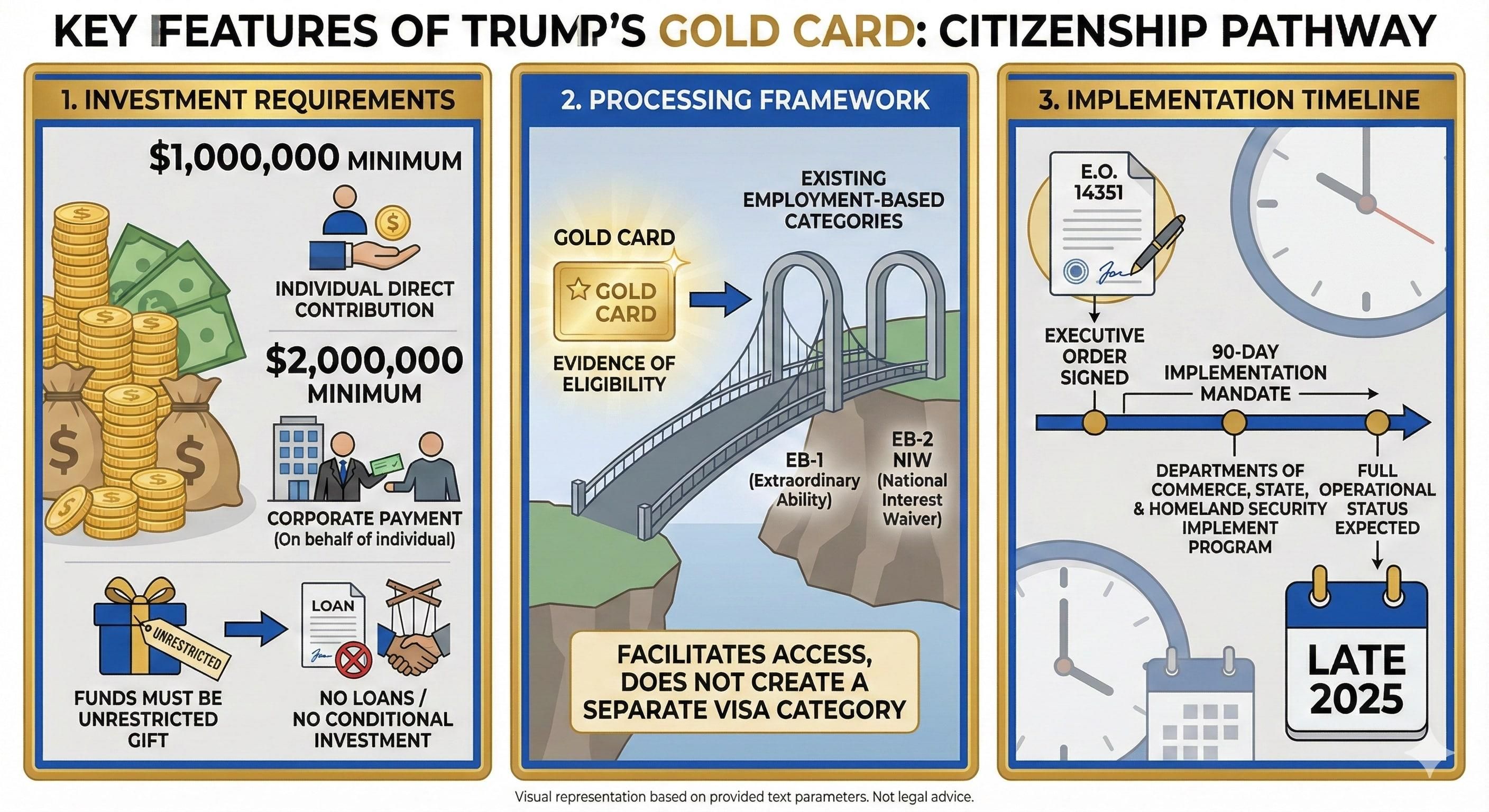
The Trump gold card citizenship pathway operates under specific parameters that differentiate it from existing programs. Here is what makes this program unique:
Investment Requirements
- $1,000,000 minimum for individual applicants making direct contributions
- $2,000,000 minimum when a corporation makes the payment on behalf of an individual.
- Funds must be provided as an unrestricted gift, not a loan or conditional investment.
Processing Framework
The gold card Trump initiative serves as evidence for immigrant visa eligibility through existing employment-based categories, primarily EB-1 (extraordinary ability) and EB-2 NIW (National Interest Waiver). This means the Trump gold card visa doesn't create a separate visa category but rather facilitates access to existing ones.
Implementation Timeline
Executive Order 14351 mandates the Departments of Commerce, State, and Homeland Security to implement the program within 90 days of the order's signing, meaning full operational status is expected by late 2025.
Misconception: Is this the same as the Trump 5 million gold card?
There is often confusion regarding the pricing. While early rumors circulated about a Trump 5 million gold card, the finalized Gold Card program requires a $1 million donation. The $5 million figure currently refers to the separate "Platinum Card" proposal, which offers different benefits regarding residency and tax status.
Understanding the EB-5 Immigrant Investor Program
The EB-5 Program has been the cornerstone of investment-based U.S. immigration since 1990. After significant reforms under the EB-5 Reform and Integrity Act of 2022 (RIA), the program continues to operate with enhanced integrity measures and remains valid through September 30, 2027.
Current EB-5 Requirements (2025)
Investment Thresholds:
- Standard investment: $1,050,000
- Targeted Employment Area (TEA) investment: $800,000
Job Creation Requirement: All EB-5 investments must create or preserve at least 10 full-time jobs for qualifying U.S. workers within two years of the investor's admission to the United States.
Program Structure:
- Direct EB-5: Investor manages their own commercial enterprise
- Regional Center EB-5: Investment through USCIS-approved regional centers (approximately 580 active as of mid-2025)
Visa Allocation: The EB-5 program receives 10,000 immigrant visas annually, divided into:
- Unreserved category: 71.43% (7,143 visas)
- Set-aside categories: 28.57% (2,857 visas)
- Rural: 20% (2,000 visas)
- High unemployment: 10% (1,000 visas)
- Infrastructure: 2% (200 visas)
Trump Gold Card vs EB-5: Comprehensive Comparison
When evaluating eb5 vs gold card options, several critical factors distinguish these pathways. Understanding the gold card vs eb5 visa differences will help you choose the right path for your immigration goals.
Investment Amount Comparison
| Feature | Trump Gold Card | EB-5 Program |
|---|---|---|
| Minimum Investment (Individual) | $1,000,000 (donation) | $800,000 (TEA) / $1,050,000 (standard) |
| Corporate Sponsorship | $2,000,000 | Not applicable |
| Return on Investment | None (unrestricted gift) | Potential returns + capital preservation |
| Job Creation Required | No | Yes (10 jobs minimum) |
The trump 5 million gold card concept initially discussed in early proposals has been replaced by the lower $1-2 million thresholds in the actual executive order. This makes the program more accessible than originally anticipated, though still targeting high-net-worth individuals.
Eligibility and Requirements
Trump Gold Card Citizenship Path:
- Make qualifying donation ($1M individual or $2M corporate)
- Meet standard immigrant visa admissibility requirements
- Pass national security vetting
- Demonstrate evidence for EB-1 or EB-2 NIW qualification
- No specific job creation mandate
- Status can be revoked for national security or inadmissibility reasons
EB-5 Program Requirements:
- Invest minimum capital in qualifying commercial enterprise
- Create 10 full-time jobs for U.S. workers
- Prove lawful source of funds
- Maintain at-risk investment throughout conditional residence period
- Meet all immigrant visa admissibility standards
- Regional center investors benefit from indirect job creation models
Processing Time and Priority
One of the most discussed aspects of the trump gold card vs eb5 debate centers on processing efficiency.
Gold Card Processing:
- Intended as an "expedited" pathway through existing EB-1 and EB-2 channels
- Still subject to per-country visa caps and priority date systems
- No guaranteed timeline yet established
- Implementation regulations still being finalized
EB-5 Processing:
- Form I-526E processing: 10-30 months (varies by category)
- Reserved categories (Rural, High Unemployment, Infrastructure) often see faster processing
- Unreserved category: Currently retrogressed for FY 2025 (no new visas available until next fiscal year)
- Countries with high demand (China, India, Vietnam) face significant backlogs
Legal Status and Permanence
EB-5 Program:
- Codified under 8 U.S.C. § 1153(b)(5)
- Protected by congressional legislation (RIA valid through September 2027)
- Cannot be eliminated by executive order alone
- Well-established legal framework with decades of case law
Trump Gold Card:
- Established by executive order (can be modified or revoked by future administrations)
- Faces potential legal challenges regarding executive authority
- No congressional authorization (yet)
- Uncertain long-term stability
EB-5 vs Trump Gold Card: Which Program is Right for You?
Choosing between the eb5 program vs gold card depends on your specific circumstances, financial capacity, and immigration priorities.
Choose the Trump Gold Card If:
- You have $1-2 million available for an unrestricted donation
- You don't want to manage an active business investment
- You qualify for EB-1 or EB-2 NIW on other merits
- You're willing to accept the program's evolving regulatory landscape
- You don't require return on investment
- You want to potentially avoid job creation requirements
Choose EB-5 Program If:
✅ You prefer investment over donation (capital preservation potential)
✅ You want a congressionally authorized, legally established program
✅ You're comfortable with job creation requirements
✅ You can access set-aside categories (Rural, High Unemployment, Infrastructure) for faster processing
✅ You want more certainty about program longevity
✅ You're working with experienced EB-5 regional centers
The Current Status of Both Programs (Late 2025)
Trump Gold Card Implementation Status
As of late 2025, the trump proposes gold card initiative has moved from proposal to formal implementation phase. The executive order requires full program deployment within 90 days, meaning application procedures, fee structures, and adjudication guidelines are being finalized by the Departments of Commerce, State, and Homeland Security.
Current Challenges:
- Legal challenges questioning executive authority to reallocate visa resources
- Uncertainty about how the donation model fits within existing immigration law
- Unclear integration with per-country caps and priority date systems
- No published regulations or application forms yet available
EB-5 Program Current Status
The eb5 green card vs gold card comparison becomes clearer when examining EB-5's current operational state. The program remains fully functional under the RIA with active adjudication of petitions.
FY 2025 EB-5 Landscape:
- Unreserved category visa numbers exhausted (retrogressed until October 2025)
- Set-aside categories still accepting applications with available visa numbers
- Approximately 580 approved regional centers operating nationwide
- May 2025 statistics: 452 EB-5 visas issued (381 unreserved, 71 reserved)
- Continued backlogs for high-demand countries (China, India, Vietnam)
Regional Center Advantages: Regional centers offer professionally managed investment projects with established job creation models, reducing investor involvement while maintaining regulatory compliance. This model has proven particularly attractive for investors who want a passive investment structure.
Gold Card vs EB-5 Visa: Financial Considerations
The financial implications of eb5 visa vs gold card options extend beyond the initial investment amount.
Total Cost Analysis
Trump Gold Card Estimated Costs:
- Donation: $1,000,000 - $2,000,000 (non-refundable)
- Administrative fees: TBD (not yet published)
- Legal fees: $25,000 - $75,000 (estimated)
- Total: $1,025,000 - $2,075,000+ with zero return
EB-5 Program Costs:
- Investment: $800,000 - $1,050,000 (potentially refundable)
- Administrative fee: $10,000 - $90,000 (varies by project)
- USCIS filing fees: $11,160 (I-526E + I-485)
- Legal fees: $30,000 - $80,000
- Regional center fees: $40,000 - $75,000
- Total: $891,160 - $1,306,160 with potential for capital return
Investment Return Potential
EB-5 Advantage: Unlike the gold card's donation model, EB-5 investments are structured to preserve capital and potentially generate returns. Many regional center projects target annual returns of 1-3% with full principal repayment after the five-year investment period.
Gold Card Reality: The trump gold card contribution is an unrestricted gift with no expectation of repayment or return. This fundamental difference makes EB-5 more attractive for investors seeking both immigration benefits and wealth preservation.
Legal and Regulatory Considerations
Understanding the legal framework surrounding both programs is essential for long-term immigration planning.
Congressional Authority vs. Executive Action
EB-5 Legal Foundation: The EB-5 program is codified in the Immigration and Nationality Act under 8 U.S.C. § 1153(b)(5). Congress passed the EB-5 Reform and Integrity Act of 2022, which strengthened oversight, increased investment thresholds, and extended program authorization through September 30, 2027. The executive branch cannot unilaterally eliminate or substantially modify EB-5 without congressional action.
Gold Card Legal Challenges: The trump immigration gold card faces scrutiny on several legal fronts:
-
Executive Authority Limits: Legal experts question whether executive orders can create new immigration pathways or reallocate visa numbers without congressional approval.
-
Statutory Framework: The gold card relies on existing EB-1 and EB-2 categories rather than creating a separate preference category, but whether a donation alone satisfies those categories' requirements remains legally untested.
-
Pending Litigation: Immigration law firms anticipate challenges arguing the executive order exceeds presidential authority under the Immigration and Nationality Act.
Coexistence or Competition?
Rather than viewing this as eb5 vs trump gold card competition, many immigration professionals predict a coexistence scenario where both programs serve different investor profiles.
Potential Integration Scenarios:
Scenario 1 - Parallel Pathways: EB-5 continues as the job-creation investment route, while the gold card serves ultra-high-net-worth individuals willing to make donations for expedited consideration.
Scenario 2 - Congressional Codification: Congress could pass legislation formally incorporating the gold card concept, either as a new preference category or as a modified EB-5 pathway with donation options.
Scenario 3 - Legal Invalidation: Courts could strike down the executive order, returning EB-5 to its position as the primary investment-based immigration program.
Application Process Comparison
Trump Gold Card Application (Anticipated Process)
While final regulations are pending, the expected trump gold card visa application process includes:
Step 1: Make Qualifying Donation
- Transfer $1M (individual) or $2M (corporate) to designated government account
- Obtain receipt and documentation of unrestricted gift
- Ensure funds derive from lawful sources
Step 2: Submit Evidence Package
- Demonstrate qualification for EB-1 or EB-2 NIW
- Provide donation confirmation
- Submit biographical information and admissibility documentation
- Pass national security vetting
Step 3: Visa Processing
- File immigrant visa application through National Visa Center
- Attend consular interview (if processing abroad)
- Adjustment of status application (if in U.S. on valid status)
Step 4: Conditional Residence
- Receive conditional permanent residence
- Maintain admissibility requirements
- Subject to status revocation for security concerns
EB-5 Application Process (Current)
The established EB-5 process offers more certainty:
Step 1: Select Investment Vehicle
- Choose between direct EB-5 or regional center investment
- Conduct due diligence on project and job creation plan
- Review offering documents and business plan
Step 2: Make Investment
- Transfer capital to project escrow account
- Document lawful source of funds with comprehensive paper trail
- Execute subscription agreement
Step 3: File I-526E Petition
- Submit petition with investment evidence
- Provide source of funds documentation
- Include job creation evidence
- Pay $11,160 filing fee
Step 4: Immigrant Visa or Adjustment
- Upon I-526E approval, apply for immigrant visa (if abroad) or adjustment of status (if in U.S.)
- Attend interview and medical examination
- Receive conditional permanent residence
Step 5: Remove Conditions
- After 2 years, file Form I-829
- Demonstrate sustained investment and job creation
- Receive unconditional permanent residence
Strategic Considerations for 2025-2026
Investors planning immigration strategies for the coming years should consider several factors when evaluating gold card trump versus EB-5 options.
Timing Considerations
Immediate EB-5 Advantages:
- Set-aside categories (Rural, High Unemployment, Infrastructure) have available visa numbers
- Established legal framework provides certainty
- No waiting for regulatory implementation
Gold Card Waiting Points:
- Regulations not yet finalized
- Application procedures not published
- Legal challenges may delay implementation
- Uncertain integration with visa quota system
Risk Assessment
EB-5 Risk Profile:
- ✅ Low legal risk (congressionally authorized)
- ⚠️ Commercial risk (investment performance varies by project)
- ⚠️ Timing risk (processing delays, retrogression)
- ✅ Well-established adjudication standards
Gold Card Risk Profile:
- ⚠️ High legal risk (executive order may face challenges)
- ⚠️ Political risk (future administration could revoke or modify)
- ✅ No commercial risk (donation, not investment)
- ⚠️ Uncertain adjudication standards (new program)
Family Considerations
Both programs allow derivative beneficiaries (spouse and unmarried children under 21), but processing times affect families differently.
EB-5 Family Benefits:
- Established concurrent filing for immediate relatives in the U.S.
- Children can maintain status with Form I-485 even after aging out
- Proven track record of successful family-based adjudications
Gold Card Family Impact:
- Family inclusion mechanisms not yet clarified
- Potential for faster processing may benefit families with children approaching 21
- Uncertain how child status protection will work
Industry Expert Perspectives
Immigration attorneys and industry organizations have weighed in on the trump proposes gold card program and its relationship to EB-5.
Immigration Law Firm Assessments
Leading firms including Fragomen, Pillsbury, Ogletree, and Wolfsdorf have published analyses highlighting:
- Legal uncertainty remains the primary concern with the gold card
- EB-5 continuation is likely regardless of gold card implementation
- Donation model represents significant departure from investment-based immigration
- Congressional action will ultimately determine how programs coexist
EB-5 Industry Response
IIUSA (Invest in the USA) and other industry organizations note:
- The gold card doesn't diminish EB-5's value proposition
- Job creation and economic impact remain strong EB-5 advantages
- Regional center infrastructure supports investor success
- Set-aside categories provide strategic advantages the gold card cannot match
Visa Retrogression and Priority Dates
Understanding how visa availability affects both programs is crucial for realistic timeline planning.
Current EB-5 Visa Bulletin Status
Unreserved Category (C5 and T5):
- All countries except China, India, Vietnam: Retrogressed for FY 2025
- China: Priority dates current for pre-2015 filers
- India: Priority dates current for pre-2020 filers
- Vietnam: Priority dates current for pre-2022 filers
Set-Aside Categories (Reserved):
- Rural (20%): Priority dates current for most countries
- High Unemployment (10%): Priority dates current
- Infrastructure (2%): Priority dates current
Gold Card Visa Availability Questions
The trump gold card citizenship pathway's integration with visa quota systems remains unresolved:
- Will gold card applicants draw from EB-1 or EB-2 visa numbers?
- Do per-country caps apply to gold card donations?
- Can the executive branch allocate additional visa numbers?
- How will priority dates function for gold card applicants?
These questions will be answered through regulatory implementation and potential litigation, making the gold card's visa availability uncertain compared to EB-5's established structure.
Making Your Decision: Action Steps
Whether you choose eb5 green card vs gold card pathways, taking informed action requires careful planning.
For EB-5 Applicants
Step 1: Identify Your Category
- Determine if your investment can qualify for set-aside categories
- Rural projects offer fastest processing and current priority dates
- High unemployment areas provide strategic advantages
Step 2: Engage Professionals
- Hire experienced EB-5 immigration attorney
- Consult with financial advisor about investment implications
- Work with reputable regional center (if choosing that route)
Step 3: Prepare Documentation
- Begin gathering source of funds evidence
- Organize financial records and tax returns
- Compile employment and business documentation
Step 4: Move Forward
- Select investment project after thorough due diligence
- Execute subscription agreement and transfer funds
- File I-526E petition promptly
For Gold Card Prospects
Step 1: Monitor Implementation
- Watch for USCIS, State Department, and Commerce Department regulations
- Track legal challenges and court decisions
- Follow industry analysis from immigration law firms
Step 2: Assess EB-1/EB-2 Qualification
- Evaluate whether you qualify for EB-1 (extraordinary ability, outstanding researcher, multinational executive)
- Consider EB-2 NIW qualification based on advanced degree and national interest
Step 3: Prepare Financially
- Ensure access to $1-2 million for donation
- Understand the donation is non-refundable
- Consult with tax professionals about implications
Step 4: Maintain Flexibility
- Keep EB-5 as backup option
- Don't wait indefinitely for gold card clarification
- Consider hybrid strategies based on timing
The Future of Investment-Based Immigration
Looking beyond 2025, the landscape of U.S. investment immigration will likely evolve through congressional action, regulatory refinement, and court decisions.
Potential Legislative Developments
Congress may address investment immigration through several mechanisms:
Comprehensive Immigration Reform: Any broad immigration legislation could incorporate both EB-5 modernization and formal gold card authorization, creating a unified framework.
EB-5 Reauthorization: With current EB-5 authorization expiring September 2027, reauthorization debates may incorporate gold card concepts or create new investment tiers.
Standalone Investment Immigration Act: Congress could pass dedicated legislation creating multiple investment pathways with varying investment levels, job creation requirements, and processing priorities.
Regulatory Evolution
Expect continued refinement of both programs through:
- USCIS policy memoranda clarifying adjudication standards
- State Department visa processing updates
- Department of Commerce guidance on economic requirements
- Enhanced integrity measures and oversight mechanisms
Frequently Asked Questions
What is the Trump gold card and how does it work?
The Trump gold card is an immigration program established by Executive Order 14351 in September 2025. It allows foreign nationals to demonstrate eligibility for U.S. immigrant visas by making substantial donations to the U.S. economy—$1 million for individuals or $2 million for corporate-sponsored applicants. The donation serves as evidence for qualification under existing employment-based visa categories like EB-1 or EB-2 NIW, rather than creating a separate visa category.
Is the Trump gold card better than EB-5?
Whether the Trump gold card is better than EB-5 depends on your priorities. The gold card requires a non-refundable donation and has no job creation requirement, making it simpler but with no investment return. EB-5 requires a lower investment ($800,000-$1,050,000) that may be refundable with potential returns, but demands job creation and active investment management. EB-5 also has congressional authorization and established legal precedent, while the gold card faces legal uncertainty as an executive order.
How much does the Trump gold card cost?
The Trump gold card requires a $1 million donation for individual applicants or $2 million if a corporation sponsors the application. These are unrestricted gifts with no expectation of return. Additional costs include legal fees ($25,000-$75,000 estimated), government filing fees (to be determined), and administrative expenses, bringing total estimated costs to $1,025,000-$2,075,000 or more.
Can I get my money back from the Trump gold card?
No, the Trump gold card donation is an unrestricted gift to support U.S. commerce and industry. Unlike EB-5 investments that are structured for potential return and capital preservation, gold card donations are non-refundable by design. This fundamental difference makes EB-5 more attractive for investors seeking both immigration benefits and wealth preservation.
What is the difference between EB-5 visa and gold card?
The EB-5 visa requires a $800,000-$1,050,000 investment in a U.S. commercial enterprise that creates 10 jobs, with potential for capital return. It's a congressionally authorized program valid through September 2027. The gold card requires a $1-2 million non-refundable donation with no job creation requirement, established by executive order with uncertain legal standing. EB-5 has established processing times and legal precedent, while the gold card is still being implemented.
How long does it take to get a green card through Trump's gold card?
Processing times for the Trump gold card are not yet established since the program is still being implemented. The executive order mandates full implementation within 90 days of September 19, 2025. However, gold card applicants will still be subject to per-country visa caps, priority date systems, and standard immigrant visa processing, which could mean wait times similar to or potentially shorter than EB-1 and EB-2 pathways. Concrete timelines won't be known until regulations are published and adjudications begin.
Is the Trump gold card program legal?
The legality of the Trump gold card is currently uncertain and expected to face legal challenges. While the program was established through Executive Order 14351, legal experts question whether the executive branch has authority to create new immigration pathways or reallocate visa resources without congressional approval. The program's long-term viability depends on whether it survives potential litigation and how courts interpret executive authority over immigrant visa allocation.
Can the Trump gold card be cancelled?
Yes, the Trump gold card program could be cancelled or significantly modified. Since it was created by executive order rather than congressional legislation, a future president could revoke or alter it. Additionally, if courts determine the executive order exceeds presidential authority, the program could be invalidated. This uncertainty contrasts with EB-5, which is codified in law and cannot be eliminated by executive action alone.
Do I need to create jobs for the Trump gold card?
No, the Trump gold card does not require job creation. Unlike EB-5, which mandates creating 10 full-time jobs for U.S. workers, the gold card pathway relies solely on the donation amount and meeting standard immigrant visa admissibility requirements. However, applicants must still demonstrate eligibility for EB-1 or EB-2 NIW status based on other qualifications.
Which countries have backlogs for EB-5?
China, India, and Vietnam face significant EB-5 backlogs in the Unreserved category due to per-country visa caps. Chinese applicants with priority dates before 2015, Indian applicants before 2020, and Vietnamese applicants before 2022 are currently eligible for visas. However, EB-5 set-aside categories (Rural, High Unemployment, Infrastructure) generally have current priority dates for all countries, offering faster pathways for qualifying investments.
Can my family get green cards through the gold card?
While the executive order mentions the gold card program will include derivative beneficiaries (spouse and unmarried children under 21), specific procedures for family members have not yet been published. The program is expected to follow similar family inclusion patterns as other employment-based immigration categories, but details await regulatory implementation.
What happens if the EB-5 program ends in 2027?
The EB-5 Reform and Integrity Act of 2022 authorized the program through September 30, 2027. If Congress doesn't reauthorize it, no new EB-5 petitions could be filed after that date, though pending cases would continue processing. However, given EB-5's economic benefits and bipartisan support for investment-based immigration, reauthorization is expected, potentially with modifications informed by the gold card experiment.
Should I wait for the gold card or apply for EB-5 now?
If you qualify for EB-5 set-aside categories (Rural, High Unemployment, Infrastructure), applying now offers advantages: current priority dates, established legal framework, and no waiting for regulatory clarity. The gold card's implementation timeline, legal challenges, and integration with visa systems remain uncertain. Most immigration attorneys recommend not delaying EB-5 applications while waiting for gold card clarification, especially given EB-5's proven track record.
What is the $5 million gold card Trump proposed?
Early proposals for Trump's gold card program discussed a $5 million investment threshold as a potential EB-5 replacement. However, the actual Executive Order 14351 set lower thresholds: $1 million for individual donations and $2 million for corporate-sponsored applicants. The $5 million figure represented initial discussions rather than the final program design.
Can I do both EB-5 and Trump gold card?
Theoretically, you could pursue both pathways simultaneously since they utilize different immigration mechanisms. However, this would require substantial capital ($1.8-3.05 million total) and doesn't provide significant advantages since both lead to permanent residence. Most investors should choose one pathway based on their financial situation, risk tolerance, and timeline requirements rather than pursuing both concurrently.
Conclusion: Navigating Your Investment Immigration Journey
The introduction of the trump gold card has added complexity to investment-based immigration planning, but it hasn't diminished the EB-5 program's fundamental value. Understanding the trump gold card vs eb5 comparison empowers you to make strategic decisions aligned with your immigration goals, financial capacity, and risk tolerance.
Key Takeaways:
-
EB-5 remains the established, legally certain pathway with congressional authorization through September 2027 and decades of precedent.
-
The Trump gold card offers a donation-based alternative currently being implemented with uncertain legal standing and timeline.
-
Investment amounts are comparable ($800,000-$1,050,000 for EB-5 vs. $1-2 million for gold card), but EB-5 offers potential returns while the gold card is a non-refundable gift.
-
Set-aside EB-5 categories (Rural, High Unemployment, Infrastructure) provide current priority dates and faster processing than unreserved categories.
-
Legal uncertainty surrounding the gold card suggests a cautious approach, while EB-5's proven framework offers reliability.
-
Both programs may coexist rather than compete, serving different investor profiles and preferences.
For most prospective investors, beginning the EB-5 process now—particularly through set-aside categories—offers the best balance of certainty, investment protection, and realistic timelines. As the trump immigration gold card program develops, you can reassess strategies based on clearer regulatory guidance and legal outcomes.

Looking Ahead: What's Next for EB-5 and the Gold Card Proposal?
Over the following months, we expect public notice rules, interagency coordination, and perhaps court rulings to shape how Gold Card and EB-5 intersect. Most likely, the outcome will be gradual shifts rather than an overnight overhaul—unless Congress steps in decisively. For now, EB-5 remains a stable, legally backed path, and the Gold Card should be considered a new option in flux.

Pages Related to #gold card trump
- EB5 Investment Visa Guide 2025

- Paperfree Investment Visa EB-5 Program is Your Your Clear Path to Green Card USA

- US Immigration: Big increase in EB–5 visa fees proposed

- EB 5 Visa Requirements 2026 ( updated ), A Guide to Eligibility for U.S. Investment-Based Residency

- July 2025 Visa Bulletin: EB-5 Program & EB-5 Investment Visa Updates for Investors

- EB-5 Regional Center Program 2027 Expiration: Secure Your Green Card Before Deadline | Renewal Updates

- Joseph Edlow Confirmed as New USCIS Director

- EB 5 investment amount and EB-5 Visa Cost 2025-2026

Popular Page
Benefits of the EB-5 Visa Program| A Comprehensive Guide
Book a Free Complimentary Call
Search within Paperfree.com
real estate investing Investment Visa USA Investment Magazine Private Real Estate Funds real estate funds