| | by Sidra Jabeen | Content Manager, Paperfree Magazine |
EB-5 Visa Processing in 2026: Critical Insights from 2025 Data and What Investors Must Know Now
i-526e, EB-5 I-526E Processing Datalast updated Tuesday, February 10, 2026
#EB-5 I-526E Processing Data #i-526e
AD
Get Access to EB 5 Visa Investment Projects
As we move through early 2026, newly released USCIS data from 2025 reveals critical trends that every EB-5 investor must understand before making their investment decision. The numbers are striking: Form I-526E approvals surged 167% from 2024 to 2025, reaching 524 total approvals—but this growth comes with important implications for investors entering the program in 2026.
If you're considering the EB-5 pathway right now, understanding what happened in 2025 and how it impacts 2026 timelines isn't just helpful—it's essential for making informed decisions about your investment, project selection, and immigration strategy. This February 2026 analysis breaks down the latest data and provides actionable guidance for investors making decisions today.
What 2025 Processing Data Reveals About 2026 Opportunities
The Dramatic Year-Over-Year Growth
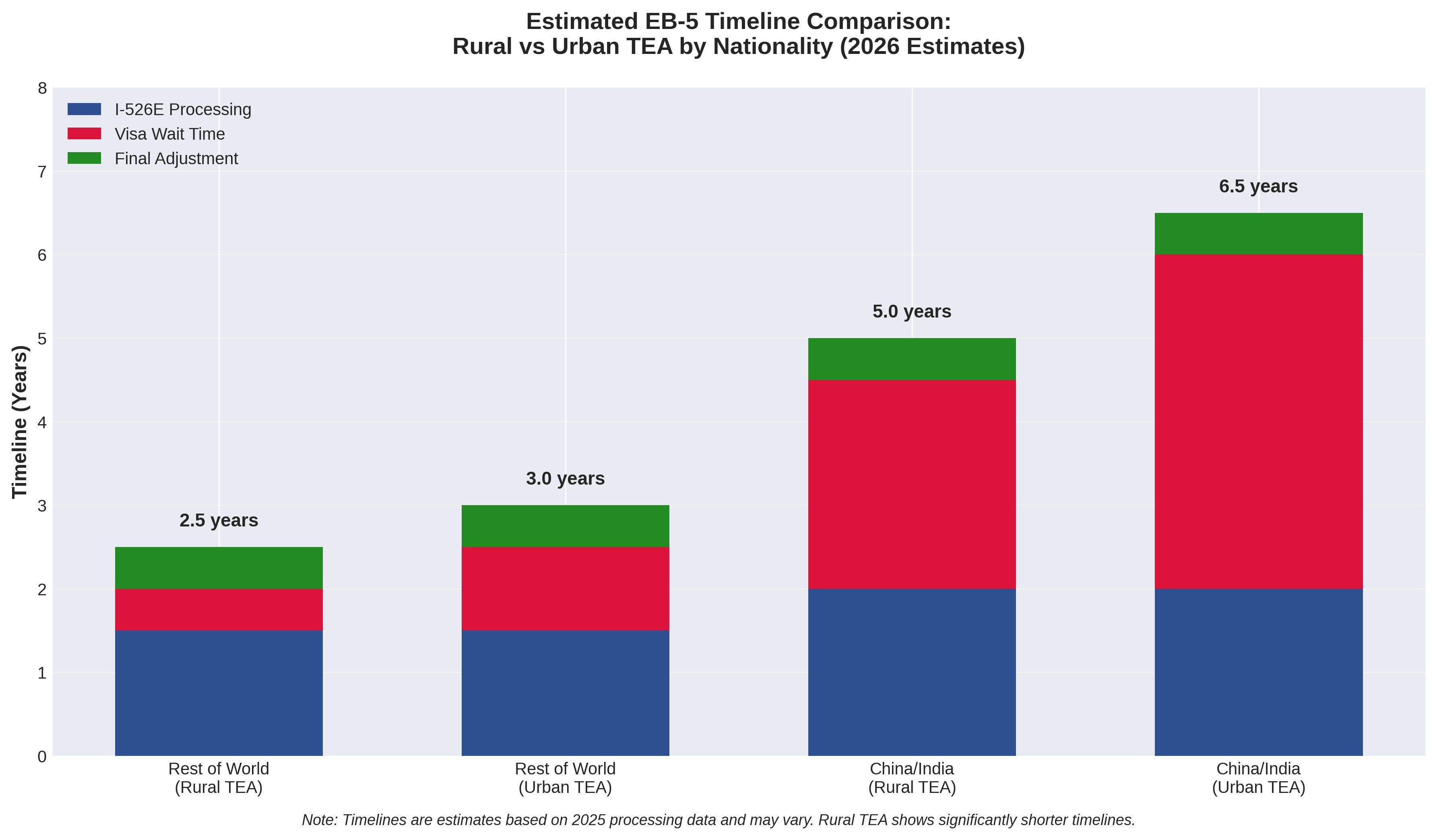
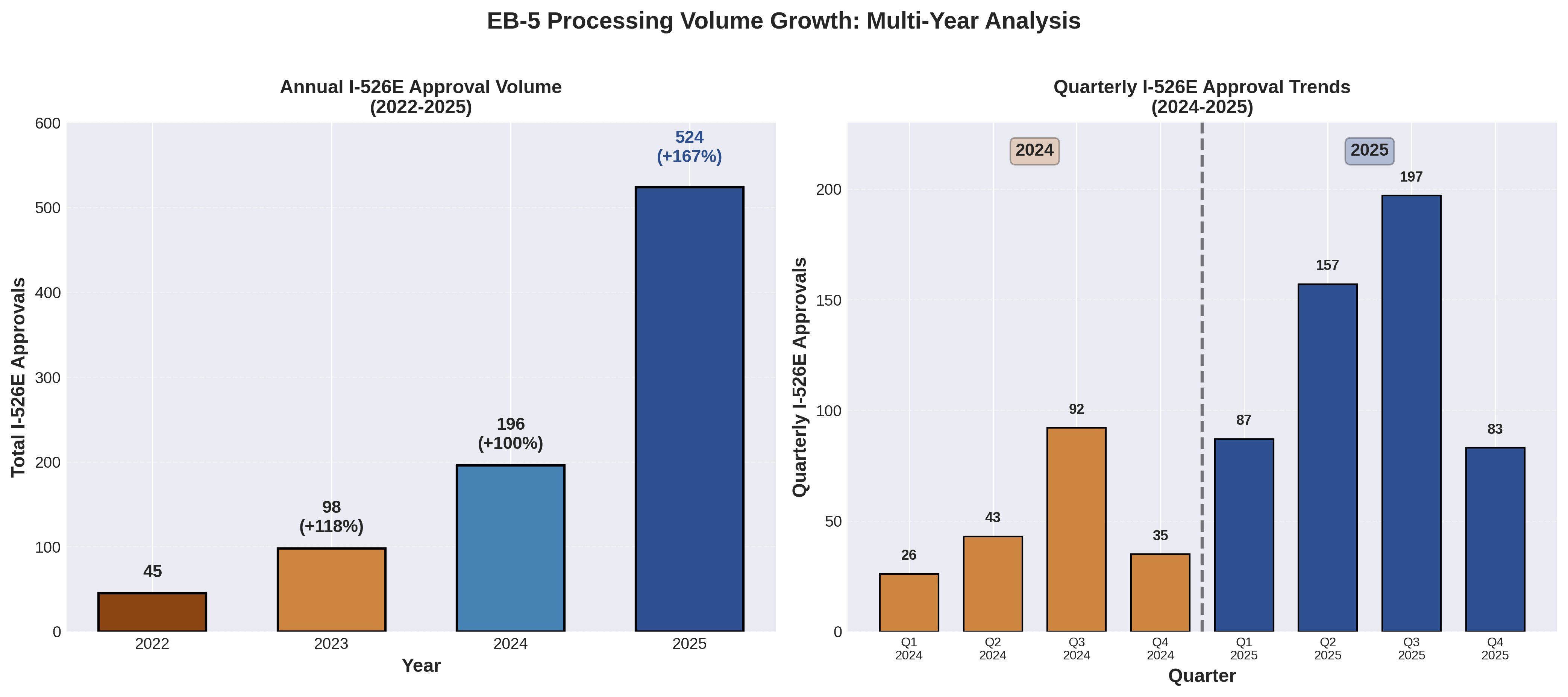
The most striking development in the newly released 2025 data is the unprecedented growth in petition approvals. In 2024, USCIS approved 196 I-526E petitions. By the end of 2025, that number had skyrocketed to 524 approvals—a staggering 167% increase. This dramatic rise reflects USCIS's enhanced capacity following the modernization reforms introduced through the EB-5 Reform and Integrity Act of 2022.
For investors making decisions in early 2026, this data provides crucial insights into what to expect for processing timelines and capacity constraints.
What the 2025 Processing Pattern Means for 2026
Breaking down the 2025 data reveals patterns that directly impact investors filing in 2026:
- First Half 2024 (H1): 69 approvals
- Second Half 2024 (H2): 127 approvals (+84%)
- First Half 2025 (H1): 244 approvals (+92%)
- Second Half 2025 (H2): 280 approvals (+15%)
The modest 15% increase from H1 to H2 2025 suggests that USCIS has reached a steady-state processing capacity. This is crucial information for investors in early 2026: you can now make more reliable timeline estimates based on this stabilized processing rate of approximately 500-550 approvals annually.
Quarterly Trends: What Q4 2025 Tells Us About 2026
Quarter-by-quarter analysis of 2025 shows important nuance for investors entering in 2026:
- Q4 2025 saw 83 approvals, down from Q3's 197 approvals
- However, Q4 2025 was still 137% higher than Q4 2024's 35 approvals
- The Q3 spike likely represented USCIS clearing a backlog before fiscal year-end
What this means for 2026 filers: While quarter-to-quarter fluctuations will continue, the overall annual capacity appears stabilized around 500-550 approvals. This should give you more confidence in timeline projections when working with experienced immigration attorneys.
Book Your Free Consultation with Paperfree EB-5 Visa Experts. Get Personalized Advice and Investment Plans. Book Your Free Consultation Today!

Rural vs. Urban TEA: The Critical Decision Point
Approval Rates Tell a Compelling Story
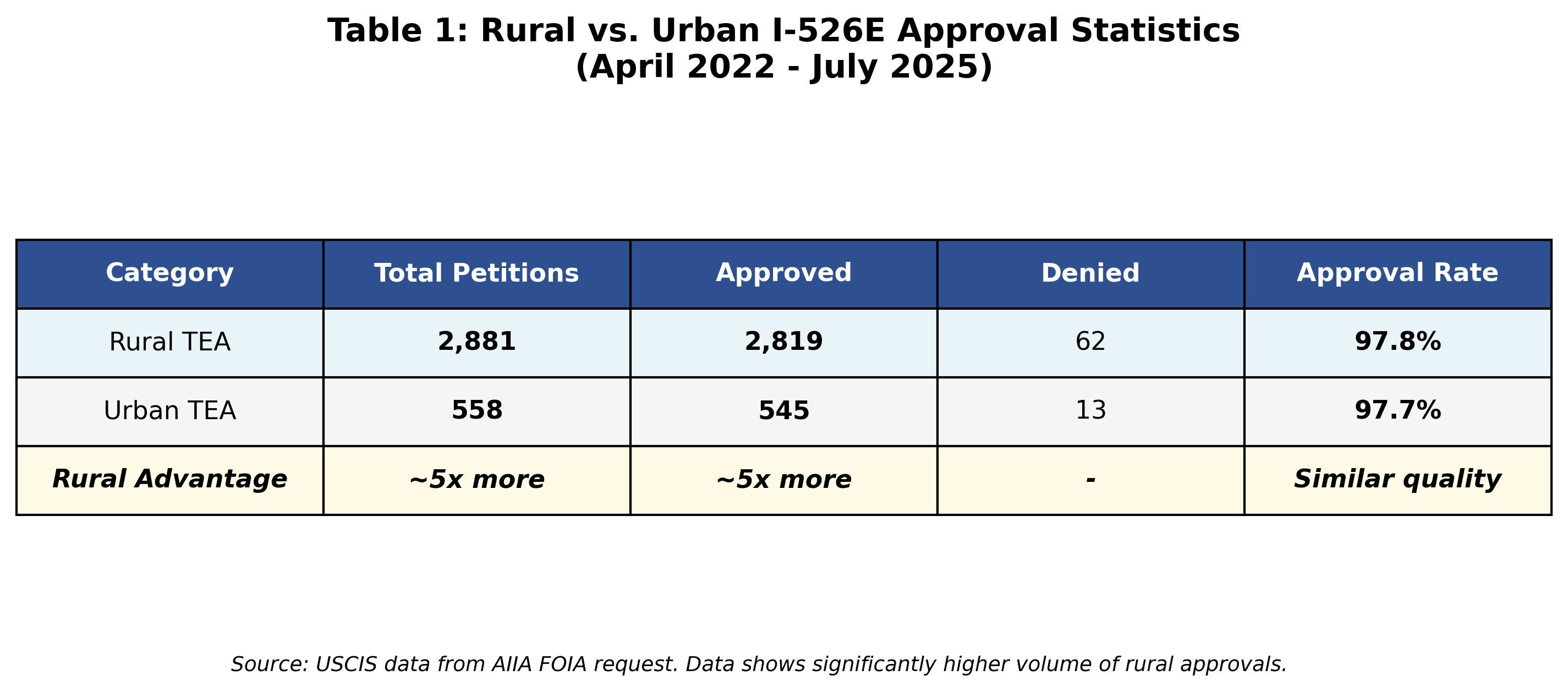
One of the most significant findings in the 2025 data is the stark difference between rural and urban Targeted Employment Area (TEA) processing:
Table 1: Rural vs. Urban I-526E Approval Statistics (April 2022 - July 2025) Data current as of latest USCIS release, January 2026
| Category | Total Petitions | Approved | Denied | Approval Rate |
|---|---|---|---|---|
| Rural TEA | 2,881 | 2,819 | 62 | 97.8% |
| Urban TEA | 558 | 545 | 13 | 97.7% |
| Rural Advantage | ~5x more | ~5x more | - | Similar quality |
While approval rates are nearly identical (both exceeding 97%), USCIS processed approximately five times more rural applications than urban applications. This massive difference has profound implications for your investment strategy.
Why Rural Projects Remain the Strategic Choice for 2026
Several factors explain the rural processing advantage that continues into 2026:
- Set-Aside Visa Allocation: Rural projects receive 20% of annual EB-5 visas (approximately 2,000 visas per year with rollover provisions)
- Proven Priority Processing: 2025 data confirmed USCIS's clear focus on adjudicating rural applications—this pattern is expected to continue
- Less Competition: Fewer projects qualify for rural designation, meaning less competition for available visas
- Policy Consistency: Government initiatives continue to prioritize economic development in underserved rural communities
For investors from high-demand countries like China and India entering the program in 2026, the rural category continues to offer significantly faster pathways to green card approval based on proven 2025 data.
Country-Specific Processing: Critical Insights for Chinese and Indian Investors
The Numbers Don't Lie
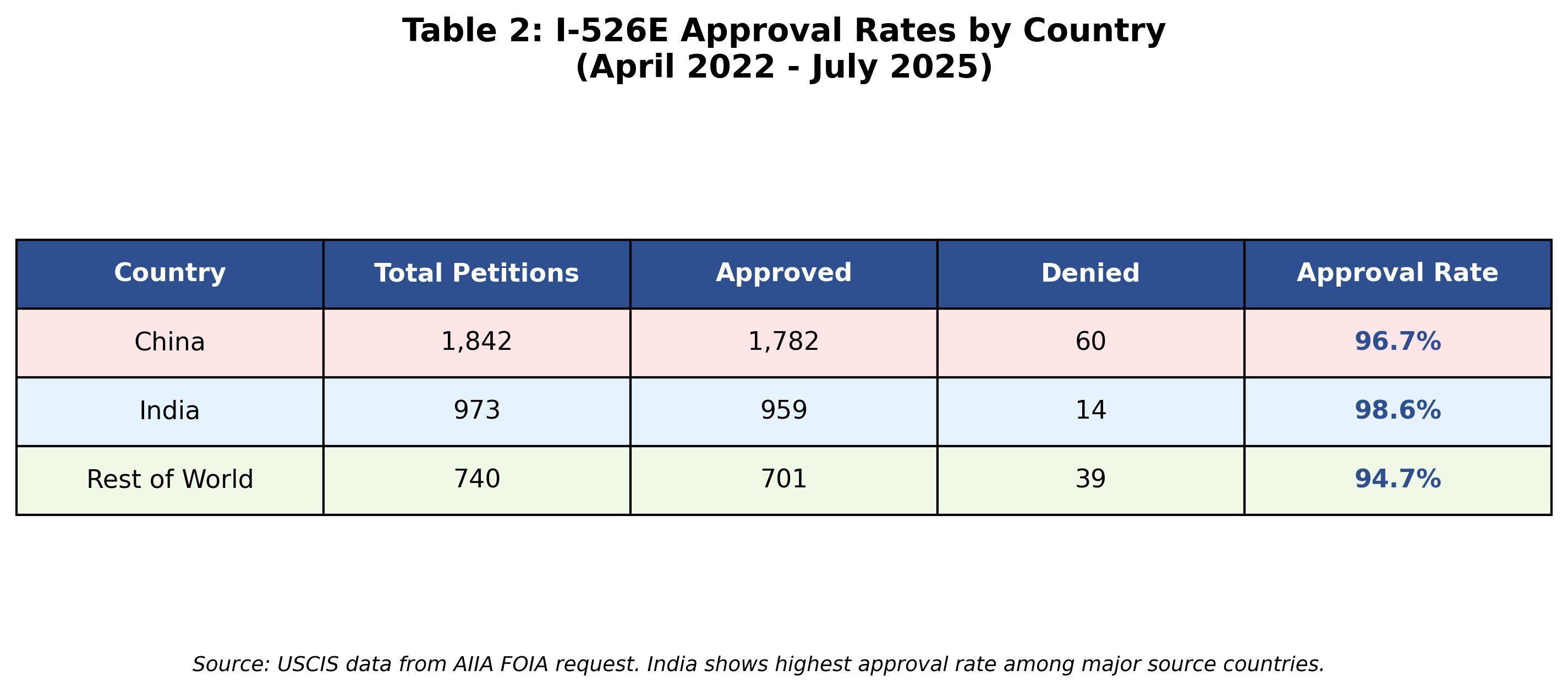
Analysis of I-526E approvals by country of birth reveals important disparities:
Table 2: I-526E Approval Rates by Country (April 2022 - July 2025) Latest data released January 2026
| Country | Total Petitions | Approved | Denied | Approval Rate |
|---|---|---|---|---|
| China | 1,842 | 1,782 | 60 | 96.7% |
| India | 973 | 959 | 14 | 98.6% |
| Rest of World | 740 | 701 | 39 | 94.7% |
Indian Applications: Lessons from 2025 for 2026 Filers
Despite having more than twice as many pending urban I-526E petitions as Chinese nationals, Indian applicants experienced notably faster adjudication rates through 2025. USCIS processed more than twice as many urban I-526E petitions for Indian nationals compared to Chinese nationals through July 2025.
This disparity may be partially attributed to the more aggressive use of mandamus actions by Indian nationals residing in the United States—legal actions that compel USCIS to make decisions on pending applications.
For 2026: This trend suggests Indian nationals filing in 2026 may continue to see relatively faster processing, though the growing backlog means early filing is still critical.
The Preference Distribution
Data from April 2022 to July 2025 shows clear preferences by nationality:
Chinese and Indian Investors:
- 56% chose Rural TEA projects
- 42% chose Urban HUA TEA projects
- Motivated by the 20% rural visa set-aside and faster processing
Rest of World Investors:
- 56% chose Urban TEA projects
- 33% chose Rural TEA projects
- Less concerned about visa backlogs, prioritizing project location and returns
[Insert Image 7 here: Form I-526E receipts by country and visa category chart]
Understanding the Growing Backlog: Critical for 2026 Investors
The Challenge of the "Invisible Backlog"
One of the most concerning aspects heading into 2026 is what industry experts call the "invisible backlog." Based on data from USCIS through July 31, 2025 (released January 2026), there's a significant gap between Form I-526E filings and actual receipts acknowledged by the agency.
Estimated visa requirements as of early 2026 (at 2.0 visas per family):
- Urban HUA TEA: 13,164 visas needed
- Rural TEA: 12,812 visas needed
With very few visas issued through 2024 and limited issuance in 2025, the backlog continues to grow. The exact extent remains unclear because visa bulletin cut-off dates have not yet been published for either category as of February 2026.
What This Means for Your 2026 Timeline
The growing backlog has several critical implications for investors filing in early 2026:
- Current Category Status: As of February 2026, both HUA and Rural TEA categories remain "Current" in the Visa Bulletin, allowing investors already in the U.S. to adjust status
- Window of Opportunity: This "Current" status may not last—retrogression could occur in late 2026 or 2027
- Flexibility for Work Authorization: Chinese and Indian investors who qualify for adjustment of status can still obtain flexible work and travel permits quickly
- Green Card Wait Times: However, actual green card receipt may take several years even after I-526E approval
- Urgency Factor: The data strongly suggests filing sooner rather than later to secure an earlier priority date before inevitable retrogression
Critical point for 2026 filers: Rural TEA is likely to experience backlog first for Indian and Chinese investors due to the high volume of approvals in 2025, though exact timing remains uncertain. Filing now locks in your place in line.
Strategic Recommendations for EB-5 Investors in 2026
Why You Must Act Now, Not Later
Based on the 2025 processing data and early 2026 trends, here's what prospective investors must do immediately:
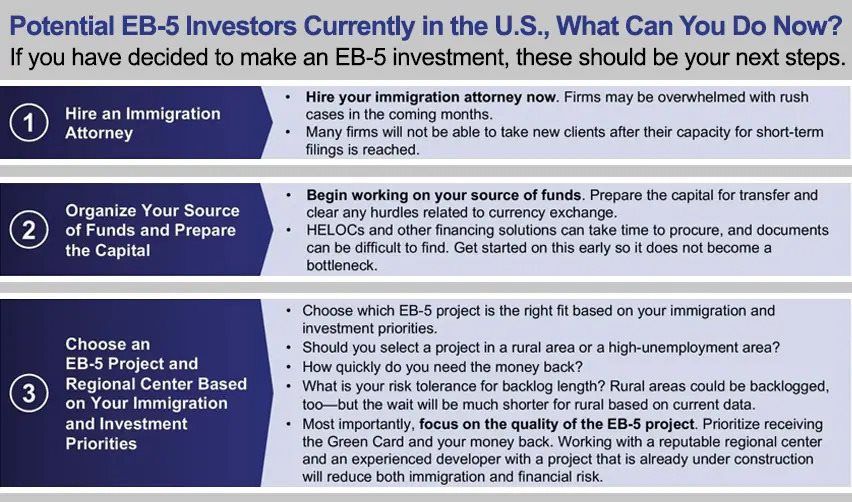
1. Hire an Immigration Attorney This Month (February 2026)
Immigration law firms are experiencing unprecedented volume entering 2026. Many top-tier firms are already at capacity and turning away new clients for immediate filings. Don't wait until March or April—every week of delay pushes your priority date further back as the backlog grows.
2. Begin Source of Funds Documentation Immediately
Currency markets, international transfers, and financing solutions all take time—often 2-3 months minimum. With potential visa retrogression looming in late 2026, starting this process now ensures it doesn't delay your filing. Home Equity Lines of Credit (HELOCs), offshore account documentation, and gift letters all require extensive preparation. Every day counts in early 2026.
3. Choose Your Project Strategically—But Don't Overthink It
The 2025 data makes the strategic calculus clearer than ever. Your project selection in 2026 should prioritize:
- Immigration speed over everything: If minimizing wait time is your goal, rural projects are the clear winner based on 2025 data
- Projects with capacity: Many rural projects filled up in late 2025—confirm your chosen project is still accepting investors
- Quality over perfection: Working with reputable regional centers with proven track records and projects already under construction is more important than finding the "perfect" location
- Lock in your priority date: Filing with a good project in February 2026 beats filing with a perfect project in June 2026
The window for "Current" visa availability may close in late 2026—your priority date matters more than marginal differences between quality projects.
Understanding Your Category Choice
Rural TEA Projects:
- Faster historical processing (approximately 2x the set-aside visas with a full carryover year)
- 20% visa allocation provides buffer against retrogression
- Dramatically reduced wait times compared to urban projects
- May experience backlog first for Chinese and Indian investors due to high volume of approvals
Urban HUA TEA Projects:
- Greater project selection in major metropolitan areas
- May align better with long-term settlement preferences
- Currently facing slower adjudication rates
- Likely longer backlog wait times for high-demand countries
The Path Forward: Making Informed Decisions
Focus on What Matters Most
The most important takeaway from the 2025 processing data is this: focus on the quality of your EB-5 project. Prioritize receiving your green card and capital return by working with:
- Reputable regional centers with proven track records
- Experienced developers with successful project completions
- Projects already under construction to minimize development risk
- Immigration attorneys specializing in EB-5 cases
Timeline Expectations for 2026 Filers
While exact backlogs remain somewhat uncertain, reasonable expectations based on 2025 trends for those filing in early 2026 include:
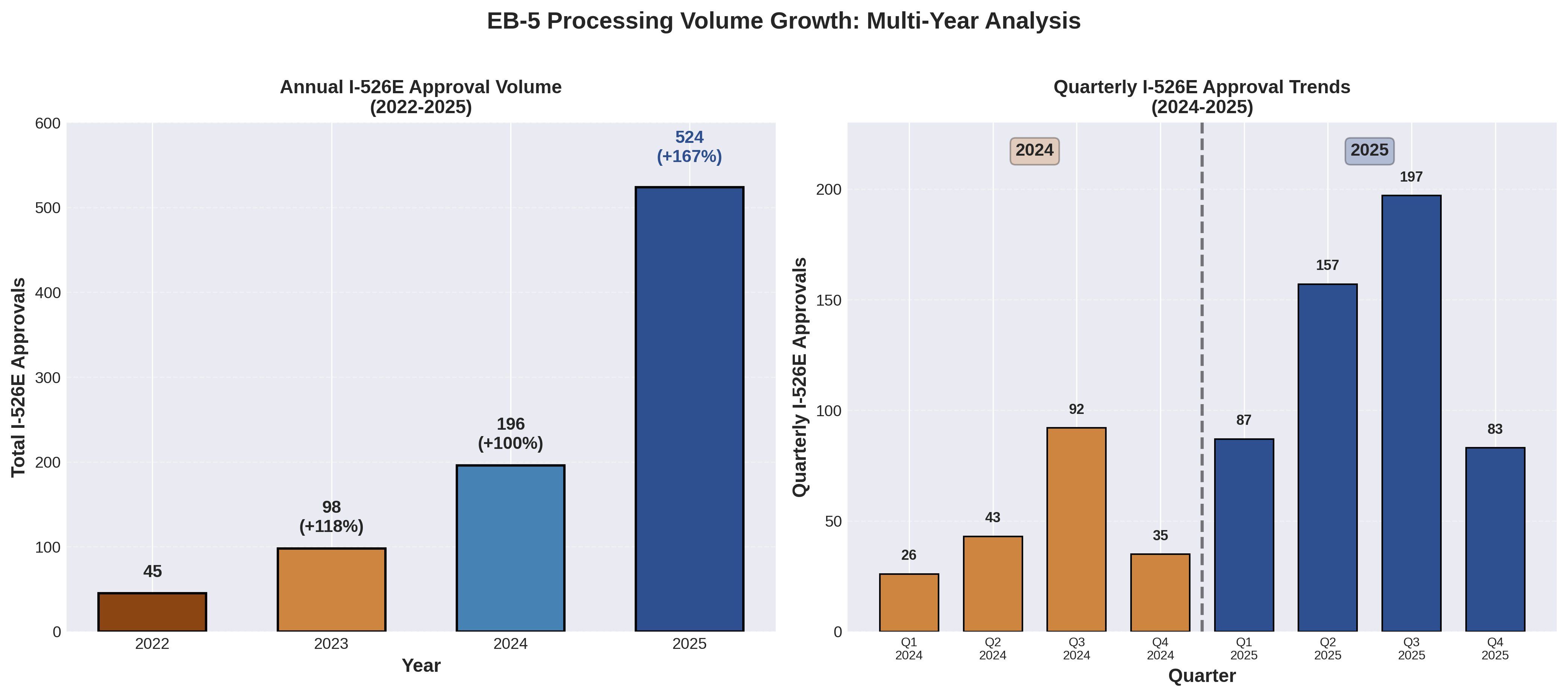
- Initial I-526E Processing: 18-30 months for approval (USCIS capacity is now stabilized)
- Visa Availability (Rural TEA - China/India): Potentially 2-4 additional years after I-526E approval
- Visa Availability (Urban TEA - China/India): Likely 4-6+ years after I-526E approval
- Total Timeline to Green Card for 2026 Filers:
- Rural TEA: 3.5-5 years (Chinese/Indian nationals)
- Urban TEA: 5-8+ years (Chinese/Indian nationals)
- Rest of World: 2-3 years (either category)
Critical caveat: These estimates assume filing in Q1 2026. Each quarter of delay could add 6-12 months to your overall timeline as the backlog grows and retrogression becomes more likely.
Policy Developments Heading into 2026
What Changed in 2025 and Continues into 2026
The 167% increase in approvals from 2024 to 2025 demonstrates that USCIS significantly enhanced its processing capabilities. As we move through 2026, these improvements continue:
- Sustained staffing levels dedicated to EB-5 adjudications
- Streamlined procedures following the Reform and Integrity Act showing consistent application
- Reduced requests for evidence (RFEs) due to clearer guidelines
- Improved coordination between USCIS service centers
Current Challenges Facing 2026 Investors
Despite improvements, several challenges persist and intensify in early 2026:
- Consulate Delays: Overseas visa issuance continues to lag at many U.S. consulates
- Retrogression Uncertainty: Visa bulletin cut-off dates could be implemented at any time in 2026
- Data Lag: February 2026 decisions are based on July 2025 data—the backlog may be worse than currently known
- Policy Risk: Potential administration priorities could shift EB-5 processing focus
Bottom line for 2026: The processing infrastructure is solid, but demand is outpacing supply. File early in 2026 to minimize risk.
Historical Context: How 2025 Compares and What It Means for 2026
Looking at the trajectory from 2022 to 2025 helps frame expectations for 2026:
- 2022: EB-5 Reform and Integrity Act implementation; slow initial processing (45 approvals)
- 2023: Gradual ramp-up as new regulations take effect (98 approvals, +118%)
- 2024: Accelerated processing begins (196 approvals, +100%)
- 2025: Peak efficiency reached (524 approvals, +167%)
- 2026 Projection: Stabilized processing likely to continue around 500-550 approvals annually
What this means for you: The growth phase is over. USCIS is now operating at steady capacity. This means:
- Processing times are more predictable for 2026 filers
- But backlogs will grow faster because demand exceeds this capacity
- Early 2026 filers get priority dates before the inevitable slowdown
Expert Insights: What Industry Leaders Say About 2026
What Immigration Attorneys Are Seeing in Early 2026
Immigration practitioners report several trends based on 2025 data and early 2026 activity:
- Surge in Consultations: January-February 2026 has seen record consultation requests as investors rush to file before potential retrogression
- Enhanced RFE Quality: Requests for evidence continue to be more targeted and specific, reducing delays
- Regional Center Scrutiny: Continued emphasis on job creation verification and project legitimacy
- Source of Funds Focus: Even more rigorous documentation requirements for demonstrating lawful source of investment capital
- Capacity Constraints: Many top firms are at capacity and cannot take new clients for Q1 2026 filing
Regional Center Developer Perspectives on 2026 Market
Developers of EB-5 projects report significant changes entering 2026:
- Rural Projects Oversubscribed: Many quality rural projects reached capacity in late 2025 or early 2026
- Investor Sophistication: Chinese and Indian investors are more informed about processing data than ever before
- Timeline Questions: The most common investor question is "when will I get my green card?" rather than "what's the return?"
- Early Bird Advantage: Projects offering spots to early 2026 filers are commanding premium interest
Financial Considerations for 2026 Investors
Investment Return Expectations Haven't Changed
While the primary goal remains immigration, the financial aspects are still important for 2026 investors:
- Typical Returns: 0-2% annual return during hold period (unchanged from 2025)
- Capital Return Timeline: 5-7 years from investment for most projects
- Risk Factors: Construction delays, market conditions, job creation shortfalls (standard risks)
- Protection Mechanisms: Escrow arrangements, project monitoring, experienced developers
2026 Note: Don't let the pursuit of marginally higher returns delay your filing. The immigration benefit vastly outweighs an extra 0.5% annual return if it means filing 6 months later and adding a year to your green card timeline.
Total Cost of EB-5 Investment in 2026
Beyond the $800,000 (rural/HUA) or $1,050,000 (standard) minimum investment amount, 2026 investors should budget for:
- Immigration attorney fees: $35,000-$70,000+ (increased from 2025 due to demand)
- Regional center administrative fees: $50,000-$85,000
- Business plan and economic analysis costs: $10,000-$15,000
- Document translation and certification: $2,000-$5,000
- Travel costs for consular processing: Variable
- Adjustment of status fees: ~$1,500 per person
Total out-of-pocket beyond investment: $100,000-$175,000 depending on family size and complexity
Conclusion: Your EB-5 Decision in February 2026—Act Now or Risk Missing the Window
The newly released 2025 processing data provides unprecedented clarity, but it also reveals an urgent timeline pressure for prospective EB-5 investors in early 2026. The key insights demand immediate action:
- Processing Has Stabilized—But at Capacity: USCIS is now consistently processing 500+ annual approvals, making timelines more predictable
- Rural Projects Offer Massive Advantages: 5x more approvals than urban projects with similar approval rates (this won't change in 2026)
- Country Matters: Indian and Chinese investors face different dynamics, but both benefit enormously from early filing
- The Window Is Closing: Backlogs are growing, categories are still "Current" as of February 2026, but retrogression is likely in late 2026
- Priority Date Is Everything: Filing in February 2026 versus August 2026 could mean the difference between a 4-year and 6-year wait
The February 2026 Urgency
As you read this in early 2026, remember that both HUA and Rural TEA categories currently remain "Current" in the Visa Bulletin. This status allows for immediate adjustment of status for those already in the U.S. However, industry experts widely expect this to change by late 2026 or early 2027 as the backlog catches up.
The critical question isn't whether to pursue EB-5—it's whether you'll file in Q1 2026 or delay until Q3-Q4 2026.
That delay could cost you:
- An additional 1-2 years waiting for your green card
- Loss of the "Current" visa status (no immediate work authorization)
- Higher attorney fees as demand continues to exceed supply
- Reduced availability of quality rural projects
Take Action This Month
For those whose timeline and financial situation align with EB-5 requirements, the data strongly supports filing immediately:
- This week: Contact 2-3 immigration attorneys specializing in EB-5 (many are already booked)
- This month: Begin gathering source of funds documentation
- By end of Q1 2026: Have your I-526E petition filed with USCIS
The 2025 data has given us the clearest picture yet of EB-5 processing—and that picture shows that early 2026 filers will be the last to enjoy relatively favorable timelines before the inevitable backlog crunch.
Don't let analysis paralysis delay your decision. The difference between a good rural project filed in February 2026 and a perfect project filed in September 2026 could be 12-18 months of additional waiting.
For personalized guidance on your EB-5 journey in 2026, consult with experienced immigration attorneys and regional centers who can help you navigate this time-sensitive pathway to American permanent residency.
The window is open now. It won't stay open forever.
This article provides general information about EB-5 processing trends and should not be construed as legal advice. EB-5 immigration laws are complex and subject to change. For advice specific to your situation, consult with a qualified immigration attorney. Processing times and approval rates are estimates based on historical data and may vary.


Pages Related to #EB-5 I-526E Processing Data
- Benefits of commercial hard money loans

- EB5 Investment Visa Guide 2025

- Paperfree Investment Visa EB-5 Program is Your Your Clear Path to Green Card USA

- US Immigration: Big increase in EB–5 visa fees proposed

- July 2025 Visa Bulletin: EB-5 Program & EB-5 Investment Visa Updates for Investors

- EB-5 for Tech Entrepreneurs: Immigration Program for Startup Founders | Paperfree

- EB-5 Regional Center Program 2027 Expiration: Secure Your Green Card Before Deadline | Renewal Updates

- EB5 Visa Bulletin June 2025: Priority Dates & Filing Updates

Popular Page
Benefits of the EB-5 Visa Program| A Comprehensive Guide
Book a Free Complimentary Call
Search within Paperfree.com
real estate investing Investment Visa USA Investment Magazine Private Real Estate Funds real estate funds